


Magazine Archive
Home -> Magazines -> Issues -> Articles in this issue -> View
Live Saver | |
Sabine FBX900 Feedback ExterminatorArticle from Sound On Sound, October 1993 | |
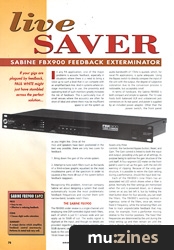
If your gigs are plagued by feedback, Paul White might just have stumbled across the perfect solution...

In any PA application, one of the major problems is acoustic feedback, especially in situations where there is a need to bring a voice up to such a level that it can compete with an amplified back-line. And in systems where onstage monitoring is in use, the proximity and operating level of such monitors greatly increases the risk of feedback. This is particularly true of small venues where the acoustics are often far short of ideal and where there may be insufficient space to set the system up as you might like. Once all the mics and speakers have been positioned in the best way possible, there are only two cures for feedback:
1. Bring down the gain of the whole system.
2. Attempt to tune notch filters (such as the bands of a third-octave graphic equaliser) to the most troublesome parts of the spectrum in order to squeeze a few more dB out of the system before feedback reappears.
Recognising this problem, American company Sabine set about designing a system that could automatically locate the most problematic feedback frequencies and counter them with narrow-band, tunable notch filters.
THE SABINE FBX900
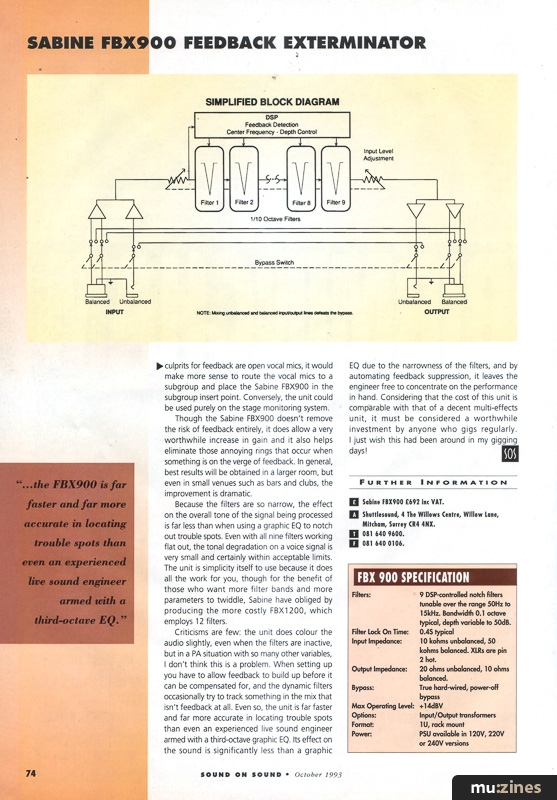
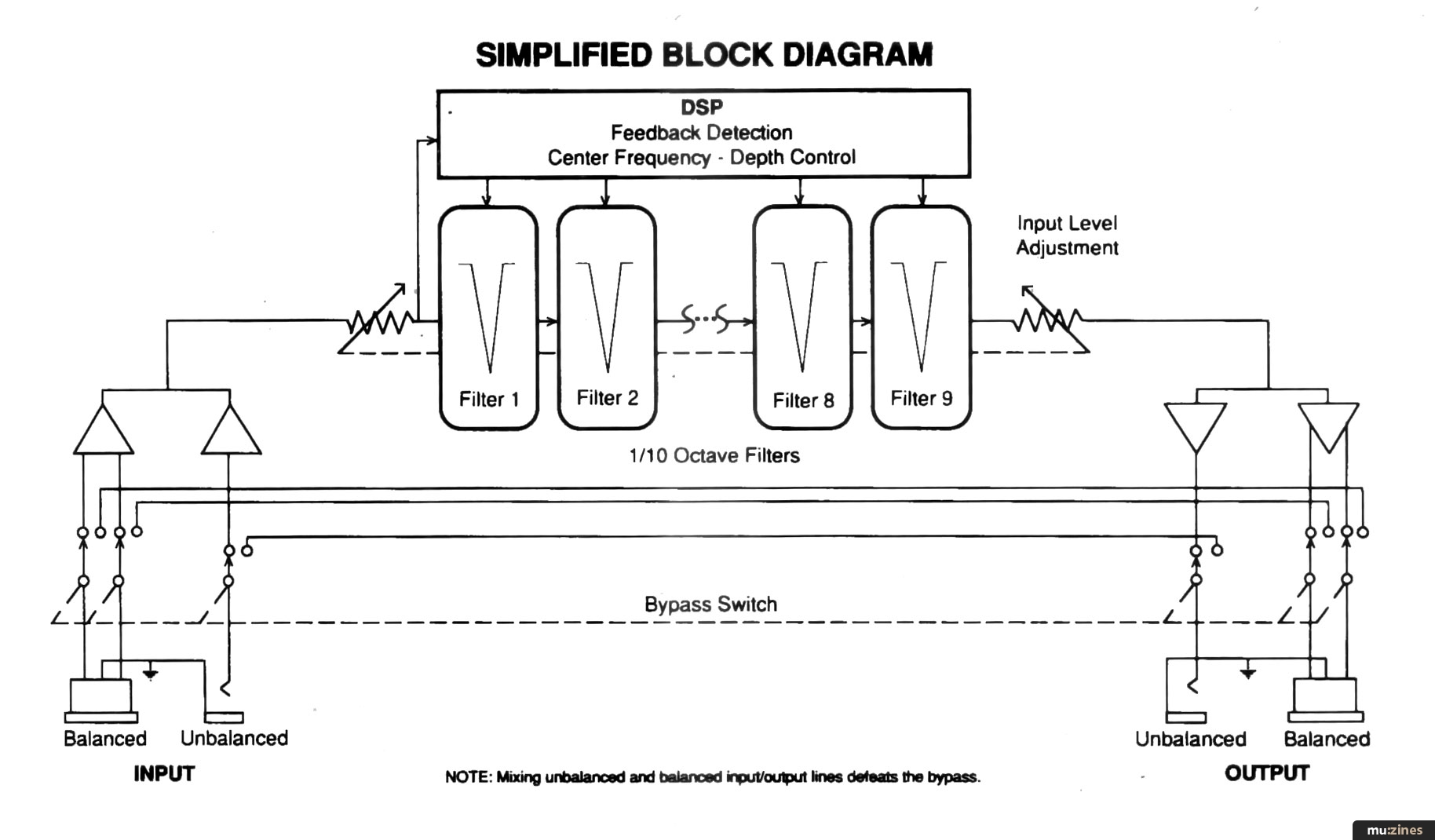
The FBX900 under review is a single-channel unit employing nine DSP-controlled digital notch filters, each of which is just 0.1 octaves wide and can apply up to 50dB of cut. The audio signal is digitised at the input, and though no details are provided regarding the conversion process, the 92dB dynamic range quoted in the documentation leads to the conclusion that a fairly conventional 16-bit linear conversion process is being used. An audio bandwidth of 17kHz is quoted, which, for vocal PA applications, is quite adequate. Using the Bypass switch to directly compare the input of the unit with the output, the degree of subjective coloration due to the conversion process is noticeable, but acceptably small.
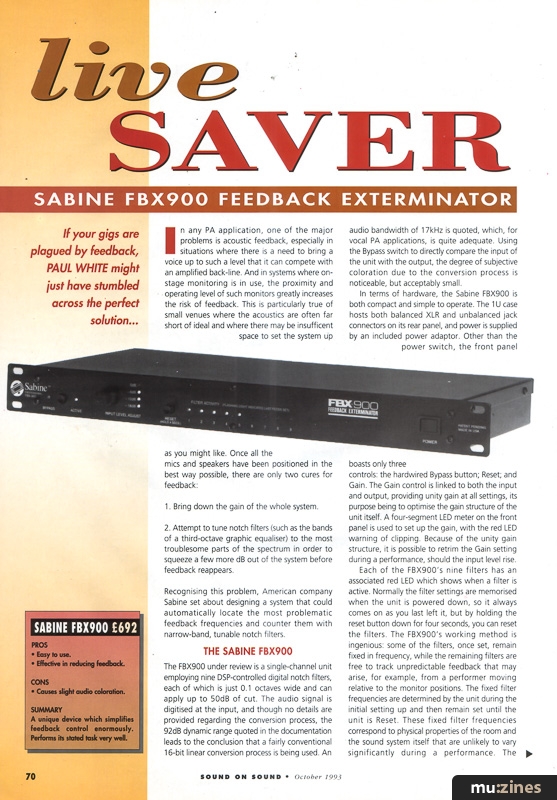
In terms of hardware, the Sabine FBX900 is both compact and simple to operate. The 1U case hosts both balanced XLR and unbalanced jack connectors on its rear panel, and power is supplied by an included power adaptor. Other than the power switch, the front panel boasts only three controls: the hardwired Bypass button; Reset; and Gain. The Gain control is linked to both the input and output, providing unity gain at all settings, its purpose being to optimise the gain structure of the unit itself. A four-segment LED meter on the front panel is used to set up the gain, with the red LED warning of clipping. Because of the unity gain structure, it is possible to retrim the Gain setting during a performance, should the input level rise.
Each of the FBX900's nine filters has an associated red LED which shows when a filter is active. Normally the filter settings are memorised when the unit is powered down, so it always comes on as you last left it, but by holding the reset button down for four seconds, you can reset the filters. The FBX900's working method is ingenious: some of the filters, once set, remain fixed in frequency, while the remaining filters are free to track unpredictable feedback that may arise, for example, from a performer moving relative to the monitor positions. The fixed filter frequencies are determined by the unit during the initial setting up and then remain set until the unit is Reset. These fixed filter frequencies correspond to physical properties of the room and the sound system itself that are unlikely to vary significantly during a performance. The manufacturers recommend using six fixed filters and three dynamic ones, though the user can change this by a simple procedure which involves turning the unit off and then powering up with the Reset button held down. On releasing the reset button, the filter LEDs come on one at a time, and when the right number are lit (corresponding to the number of fixed filters required), press Reset again. The fixed filter LEDs will then flash three times to confirm that the procedure was successful. They also flash whenever the unit is powered up.
"...the FBX900 is far faster and far more accurate in locating trouble spots than even an experienced live sound engineer armed with a third-octave EQ."
SETTING UP
Setting up the FBX900 is a doddle — after resetting the filters, simply turn up the system level until feedback starts. As it builds up, one of the fixed filters will come into action to counter it. Continue to turn up the gain until the next feedback frequency occurs and again, a filter will lock on and kill it. This should be continued until all six filter lights are on. At this point there may be a little feedback ring due to the next feedback frequency which hasn't built up enough energy to activate a filter, so the correct procedure is to back off the gain by a dB or so just to clean up the sound. The remaining three filters are now free to lock onto any spurious feedback as it occurs. Note that a little feedback will be audible for a second or two before the filters lock on and remove it, a flashing filter LED indicating the last filter to be adjusted. Occasionally one of the fixed filter LEDs will flash, signifying that the system has increased the depth of filtering at that frequency — it doesn't mean the filter has been retuned.
The variable filters are allocated in a manner similar to synthesizer polyphony, so if all the filters are used up and feedback is still present, one of the previously deployed variable filters will be commandeered to tackle it. If the change in feedback frequency is simply due to the singer moving around, then it's probably OK, but if the system gain is so high that there are more feedback frequencies than there are available filters, then feedback will return. In this case, the only option is to reduce the system gain slightly.
(Click image for higher resolution version)
OPINION
Because this system is only mono, it isn't suitable for processing a whole PA mix, but as the main culprits for feedback are open vocal mics, it would make more sense to route the vocal mics to a subgroup and place the Sabine FBX900 in the subgroup insert point. Conversely, the unit could be used purely on the stage monitoring system.
Though the Sabine FBX900 doesn't remove the risk of feedback entirely, it does allow a very worthwhile increase in gain and it also helps eliminate those annoying rings that occur when something is on the verge of feedback. In general, best results will be obtained in a larger room, but even in small venues such as bars and clubs, the improvement is dramatic.
Because the filters are so narrow, the effect on the overall tone of the signal being processed is far less than when using a graphic EQ to notch out trouble spots. Even with all nine filters working flat out, the tonal degradation on a voice signal is very small and certainly within acceptable limits. The unit is simplicity itself to use because it does all the work for you, though for the benefit of those who want more filter bands and more parameters to twiddle, Sabine have obliged by producing the more costly FBX1200, which employs 12 filters.
Criticisms are few: the unit does colour the audio slightly, even when the filters are inactive, but in a PA situation with so many other variables, I don't think this is a problem. When setting up you have to allow feedback to build up before it can be compensated for, and the dynamic filters occasionally try to track something in the mix that isn't feedback at all. Even so, the unit is far faster and far more accurate in locating trouble spots than even an experienced live sound engineer armed with a third-octave graphic EQ. Its effect on the sound is significantly less than a graphic EQ due to the narrowness of the filters, and by automating feedback suppression, it leaves the engineer free to concentrate on the performance in hand. Considering that the cost of this unit is comparable with that of a decent multi-effects unit, it must be considered a worthwhile investment by anyone who gigs regularly. I just wish this had been around in my gigging days!
Further Information
Sabine FBX900 £692 inc VAT.
Shuttlesound, (Contact Details).
SABINE FBX900 £692
• Easy to use.
• Effective in reducing feedback.
CONS
• Causes slight audio coloration.
SUMMARY
A unique device which simplifies feedback control enormously. Performs its stated task very well.
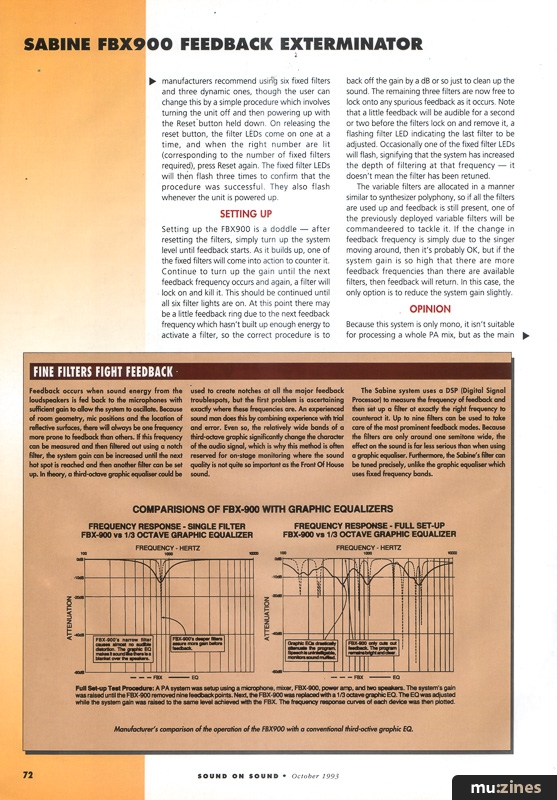
FINE FILTERS FIGHT FEEDBACK

Manufacturer's comparison of the operation of the FBX900 with a conventional third-octave graphic EQ.
(Click image for higher resolution version)
The Sabine system uses a DSP (Digital Signal Processor) to measure the frequency of feedback and then set up a filter at exactly the right frequency to counteract it. Up to nine filters can be used to take care of the most prominent feedback modes. Because the filters are only around one semitone wide, the effect on the sound is far less serious than when using a graphic equaliser. Furthermore, the Sabine's filler can be tuned precisely, unlike the graphic equaliser which uses fixed frequency bands.
FBX 900 SPECIFICATION
| Filters: | 9 DSP-controlled notch filters tunable over the range 50Hz to 15kHz. Bandwidth 0.1 octave typical, depth variable to 50dB. Filter Lock On Time: 0.4S typical |
| Input Impedance: | 10 kohms unbalanced, 50 kohms balanced. XLRs are pin 2 hot. |
| Output Impedance: | 20 ohms unbalanced, 10 ohms balanced. |
| Bypass: | True hard-wired, power-off bypass |
| Max Operating Level: | +14dBV |
| Options: | Input/Output transformers |
| Format: | 1U, rack mount |
| Power: | PSU available in 120V, 220V or 240V versions |
Publisher: Sound On Sound - SOS Publications Ltd.
The contents of this magazine are re-published here with the kind permission of SOS Publications Ltd.
The current copyright owner/s of this content may differ from the originally published copyright notice.
More details on copyright ownership...

Sound On Sound - Oct 1993
Review by Paul White
Help Support The Things You Love
mu:zines is the result of thousands of hours of effort, and will require many thousands more going forward to reach our goals of getting all this content online.
If you value this resource, you can support this project - it really helps!
Donations for May 2026
Issues donated this month: 0
New issues that have been donated or scanned for us this month.
Funds donated this month: £0.00
All donations and support are gratefully appreciated - thank you.
Magazines Needed - Can You Help?
Do you have any of these magazine issues?
If so, and you can donate, lend or scan them to help complete our archive, please get in touch via the Contribute page - thanks!
Please Contribute to mu:zines by supplying magazines, scanning or donating funds. Thanks!
Monetary donations go towards site running costs, and the occasional coffee for me if there's anything left over!

 @mu_zines
 RSS Feed
 Blog
Blog