


Magazine Archive
Home -> Magazines -> Issues -> Articles in this issue -> View
LaunchPad | |
Samson MixPad 12Article from Sound On Stage, March 1997 | |
If you need a small PA mixer, or simply want to add more input channels to your existing mixer/amp setup, the Samson Mix Pad 12 offers an attractive combination of portability, rugged construction, and good audio performance. Paul White puts it through its paces.
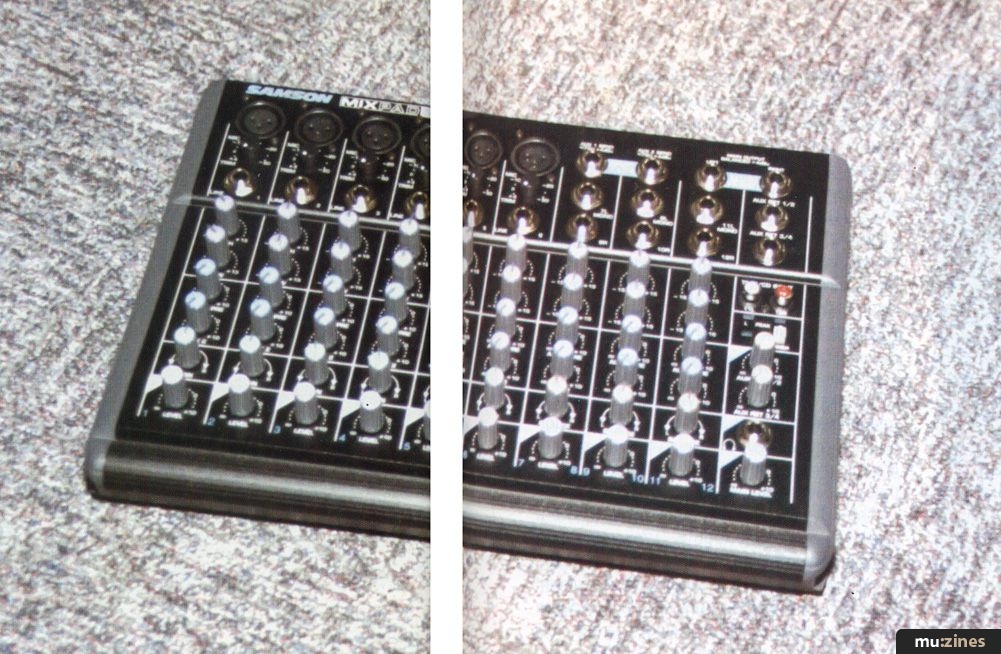
The world is full of mini mixers, some of which are extremely good, but if small is beautiful, then Samson's MixPad 12 has a head start. Physically, the mixer is about the same size and thickness as a copy of the Yellow Pages, but there is no sense of control overcrowding, and all the legending is large enough to remain clearly visible in less than perfect gigging conditions. Clear line markers are also provided on the colour coded control knobs.
An external PSU provides the power. Admittedly external power supplies are a nuisance, but this one is sensibly rugged and terminates in a 5-pin DIN plug — just make sure you don't inadvertently plug it into a MIDI socket! One positive aspect of external mains units is that ground loop problems are less likely, reducing the chance of hum.
IN CONTROL
Counting the two stereo returns, there are 16 inputs, not including the phono tape ins which mix with the channel 11/12 signals at unity gain. Channels 1 to 6 accept either balanced mics (or DI boxes) on XLR, or line-level signals on balanced TRS jacks or standard unbalanced jacks. The remaining three channels, which are stereo, are compatible with such sources as synthesizers, drum machines, tape machines, CD players, guitar effect/preamps, and other line-level devices.
All six mic/line inputs are electronically balanced and are adjusted using small trim controls, situated directly under the XLR mic sockets. Phantom power is permanently supplied to all the mic inputs, which means that only balanced mics can be used. Dynamic mics are quite happy running into phantom powered inputs, but they must be balanced, otherwise the sound quality will deteriorate dramatically; there's even a possibility of damaging the mic. Having said that, virtually all low impedance mics (which is what mixers with XLR inputs are designed to work with) have balanced XLR outputs. Unbalanced mics tend to have fixed leads with a mono jack on the end. If you wish to use one of these, you'll need to obtain an inexpensive high-to-low impedance transformer adaptor. If your music shop can't help, your local branch of Tandy may have something suitable.
The stereo line channels are unbalanced, with separate jacks for the left and right inputs, but with just a single set of controls. Using the left input only configures the channel for mono use by internally routing the input to both left and right channels so you can use the Balance control as a pan control and treat the channel exactly like any other mono channel.
A reassuringly musical, twin band, high/low EQ (±15dB at 100Hz and 10kHz) is provided on all the channels, along with one pre and one post-fade aux send, plus a pan/balance control. The pre-fade send would normally be used for driving a stage monitor amp/speaker system, whereas the post-fade send is designed to be used with external effects, such as reverb or echo. There are no aux send master controls, although this is rarely a problem as effects units invariably have input level controls. Level controls on unbalanced jacks are provided for the two stereo returns; rotary controls are used for the master output and all the channel gains. While some users may feel faders are preferable, on a small mixer like this, it doesn't make a huge difference to ease of operation.
"The MixPad 12 is a very simple mixer to use."
Headphone monitoring is catered for by a sensibly powerful, stereo headphone outlet, and the phones level is controlled by the Main Level pot. All the line ins and outs work at a nominal +4dBu level, although they are equally happy with -10dBV signals. Conventional metering has been replaced by a pair of peak LEDs. There are no insert points, either on the channels or on the stereo output. Considering the uses to which this mixer is likely to be put, that shouldn't present a problem — it's unlikely that compressors or gates will be used on individual mic inputs (a decent compressor or gate would cost nearly as much as the mixer!). Overall compression or EQ can be handled by patching the device in question between the mixer output and the power amplifier input.
IN USE
On paper, the MixPad 12 has a reassuringly low noise floor and a very wide frequency response (5Hz to in excess of 50kHz within ±3dB), low distortion, quite acceptable crosstalk, and a maximum input level of +22dBu which provides adequate headroom. Tested with a high quality studio microphone, the output was free of hiss and sounded very clear, which is just as I'd expect from a well-designed mixer. As a rule, the smaller and simpler the mixer, the cleaner the sound.
The MixPad 12 is a very simple mixer to use. Any corners that have been cut have been done so by simplifying or omitting features, not by compromising sound quality. Perhaps the metering could have been a little better, and it would be nice to have EQ bypass buttons and channel mutes, but I don't think anyone will have problems.
Suitable applications include live performance where stereo keyboards and/or backing tapes need to be mixed with up to six microphones, but the MixPad 12 would also make a useful keyboard mixer in its own right. Providing you could find some way to fix it down (double-sided sticky pads?), it could also form the basis of a practical house sound system for a small club or pub where space is limited. For those needing fewer mic inputs, there's also a MixPad 9 (£199 inc VAT), featuring three mic/line channels and three stereo line channels.
Possibly the best news is the price. The MixPad 12 costs only £275, and for a limited period, Samson are also including a free Samson cardioid, dynamic stage mic.
MixPad 12 £275 inc VAT.
Sound Technology plc, (Contact Details)
pros & cons
pros
- Cost-effective.
- Good audio quality.
- Compact and easy to use.
cons
- Very rudimentary metering.
- External PSU can be inconvenient.
summary
A well-specified, compact mixer for use in all applications where the mixing requirements aren't unduly sophisticated.
Publisher: Sound On Stage - SOS Publications Ltd.
The contents of this magazine are re-published here with the kind permission of SOS Publications Ltd.
The current copyright owner/s of this content may differ from the originally published copyright notice.
More details on copyright ownership...

Sound On Stage - Mar 1997
Review by Paul White
Help Support The Things You Love
mu:zines is the result of thousands of hours of effort, and will require many thousands more going forward to reach our goals of getting all this content online.
If you value this resource, you can support this project - it really helps!
Donations for April 2026
Issues donated this month: 0
New issues that have been donated or scanned for us this month.
Funds donated this month: £0.00
All donations and support are gratefully appreciated - thank you.
Magazines Needed - Can You Help?
Do you have any of these magazine issues?
If so, and you can donate, lend or scan them to help complete our archive, please get in touch via the Contribute page - thanks!
If you're enjoying the site, please consider supporting me to help build this archive...
...with a one time Donation, or a recurring Donation of just £2 a month. It really helps - thank you!

 @mu_zines
 RSS Feed
 Blog
Blog