
Magazine Archive
Home -> Magazines -> Issues -> Articles in this issue -> View
Beyond E Major (Part 5) | |
Article from One Two Testing, August 1984 | |
play jazz guitar and live
Improve your fretboard knowledge as Billy Jenkins investigates minor 9ths and muscle power.
Did you manage to get into Carlos Santanas' Trousers last month?
If you successfully turned the sequence into a pleasant sound you have every right to feel pretty pleased with yourself. Did you remember to concentrate on BOTH hands? R.H. application can make a big difference to the sound emanating from your Winfield Chet Atkins Humbucking Jazz Master.
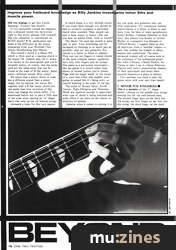
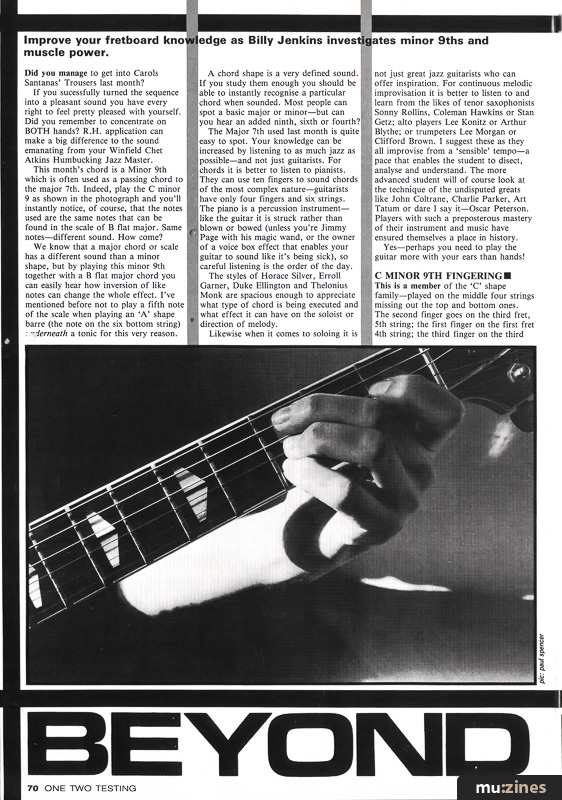
This month's chord is a Minor 9th which is often used as a passing chord to the major 7th. Indeed, play the C minor 9 as shown in the photograph and you'll instantly notice, of course, that the notes used are the same notes that can be found in the scale of B flat major. Same notes – different sound. How come?
We know that a major chord or scale has a different sound than a minor shape, but by playing this minor 9th together with a B flat major chord you can easily hear how inversion of like notes can change the whole effect. I've mentioned before not to play a fifth note of the scale when playing an 'A' shape barre (the note on the six bottom string) : underneath a tonic for this very reason.
A chord shape is a very defined sound. If you study them enough you should be able to instantly recognise a particular chord when sounded. Most people can spot a basic major or minor – but can you hear an added ninth, sixth or fourth?
The Major 7th used last month is quite easy to spot. Your knowledge can be increased by listening to as much jazz as possible – and not just guitarists. For chords it is better to listen to pianists. They can use ten fingers to sound chords of the most complex nature – guitarists have only four fingers and six strings. The piano is a percussion instrument – like the guitar it is struck rather than blown or bowed (unless you're Jimmy Page with his magic wand, or the owner of a voice box effect that enables your guitar to sound like it's being sick), so careful listening is the order of the day.
The styles of Horace Silver, Erroll Garner, Duke Ellington and Thelonius Monk are spacious enough to appreciate what type of chord is being executed and what effect it can have on the soloist or direction of melody.
Likewise when it comes to soloing it is not just great jazz guitarists who can offer inspiration. For continuous melodic improvisation it is better to listen to and learn from the likes of tenor saxophonists Sonny Rollins, Coleman Hawkins or Stan Getz; alto players Lee Konitz or Arthur Blythe; or trumpeters Lee Morgan or Clifford Brown. I suggest these as they all improvise from a 'sensible' tempo – a pace that enables the student to dissect, analyse and understand. The more advanced student will of course look at the technique of the undisputed greats like John Coltrane, Charlie Parker, Art Tatum or dare I say it – Oscar Peterson. Players with such a preposterous mastery of their instrument and music have ensured themselves a place in history.
Yes – perhaps you need to play the guitar more with your ears than hands!
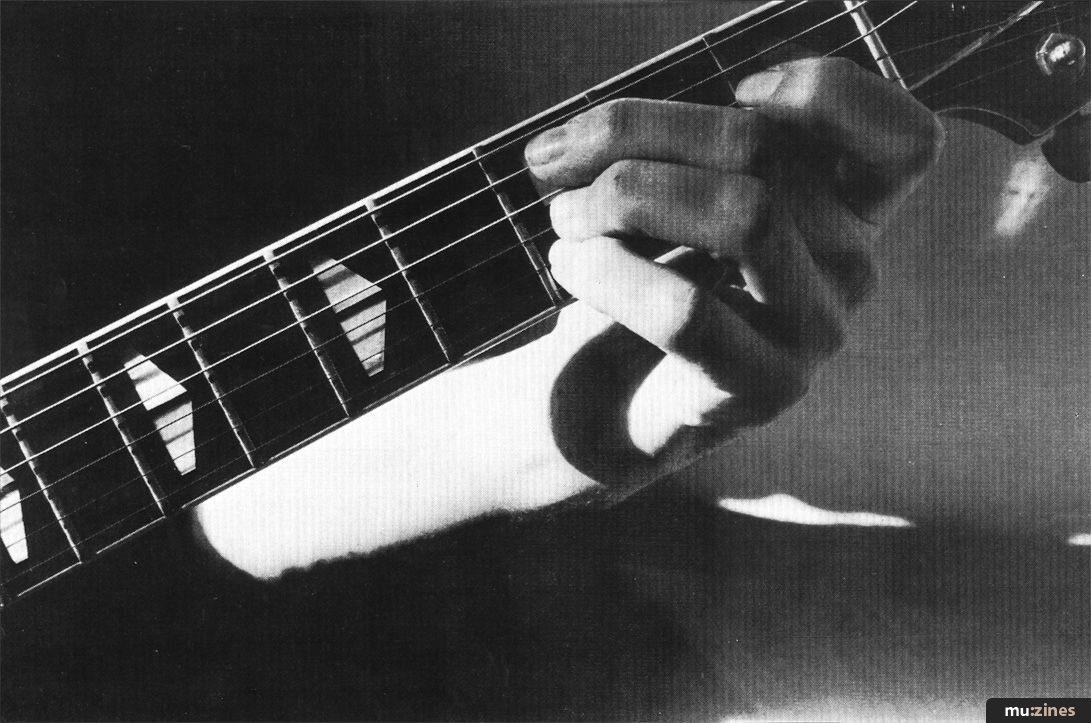
C MINOR 9TH FINGERING
This is a member of the 'C' shape family – played on the middle four strings missing out the top and bottom ones. The second finger goes on the third fret, 5th string; the first finger on the first fret 4th string; the third finger on the third fret 3rd string; and the fourth finger on the third fret 2nd string. It is the same as an ordinary ninth (as shown in the May Issue of OTT) excepting the first finger which is moved back a fret to denote the minor.
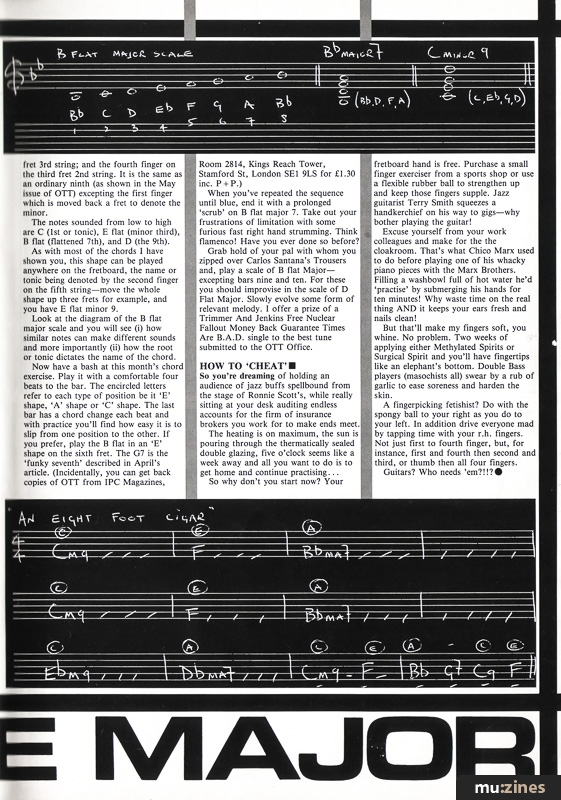
The notes sounded from low to high are C (1st or tonic), E flat (minor third), B flat (flattened 7th), and D (the 9th).
As with most of the chords I have shown you, this shape can be played anywhere on the fretboard, the name or tonic being denoted by the second finger on the fifth string – move the whole shape up three frets for example, and you have E flat minor 9.
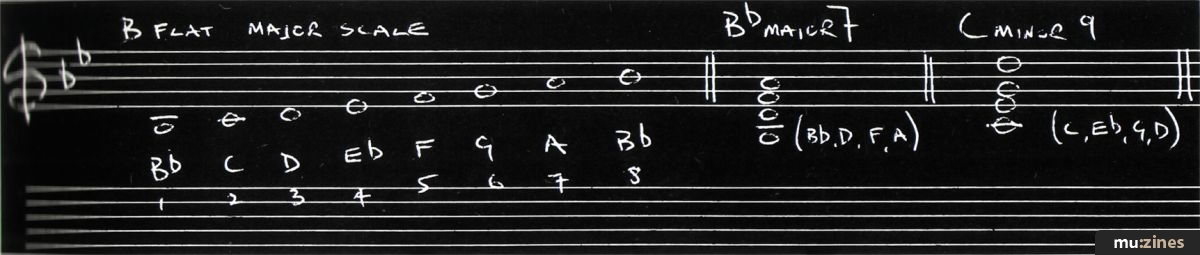
Look at the diagram of the B flat major scale and you will see (i) how similar notes can make different sounds and more importantly (ii) how the root or tonic dictates the name of the chord.
Now have a bash at this month's chord exercise. Play it with a comfortable four beats to the bar. The encircled letters refer to each type of position be it 'E' shape, 'A' shape or 'C' shape. The last bar has a chord change each beat and with practice you'll find how easy it is to slip from one position to the other. If you prefer, play the B flat in an 'E' shape on the sixth fret. The G7 is the 'funky seventh' described in April's article. (Incidentally, you can get back copies of OTT from IPC Magazines, (Contact Details) for £1.30 inc. P+P.)
When you've repeated the sequence until blue, end it with a prolonged 'scrub' on B flat major 7. Take out your frustrations of limitation with some furious fast right hand strumming. Think flamenco! Have you ever done so before?
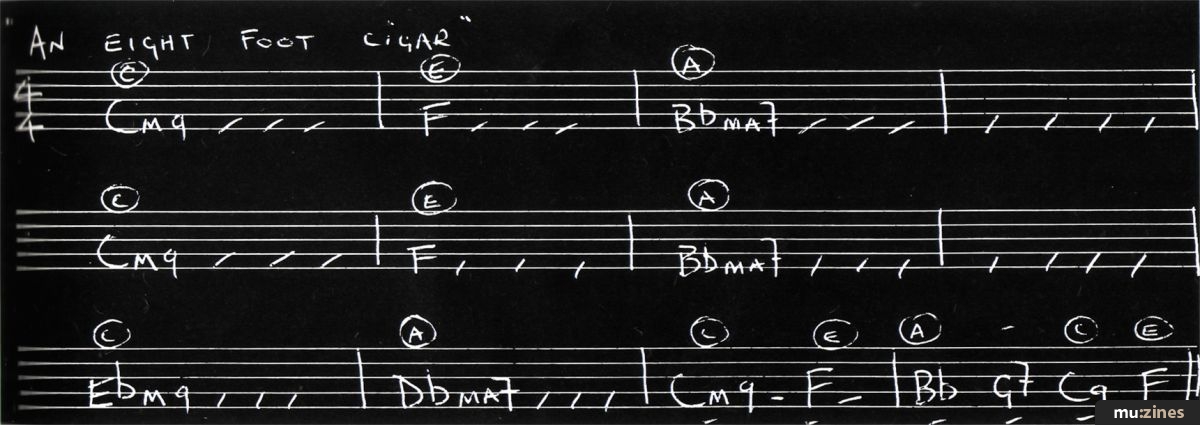
Grab hold of your pal with whom you zipped over Carlos Santana's Trousers and, play a scale of B flat Major – excepting bars nine and ten. For these you should improvise in the scale of D Flat Major. Slowly evolve some form of relevant melody. I offer a prize of a Trimmer And Jenkins Free Nuclear Fallout Money Back Guarantee Times Are B.A.D. single to the best tune submitted to the OTT Office.
HOW TO 'CHEAT'
So you're dreaming of holding an audience of jazz buffs spellbound from the stage of Ronnie Scott's, while really sitting at your desk auditing endless accounts for the firm of insurance brokers you work for to make ends meet.
The heating is on maximum, the sun is pouring through the thermatically sealed double glazing, five o'clock seems like a week away and all you want to do is to get home and continue practising...
So why don't you start now? Your fretboard hand is free. Purchase a small finger exerciser from a sports shop or use a flexible rubber ball to strengthen up and keep those fingers supple. Jazz guitarist Terry Smith squeezes a handkerchief on his way to gigs – why bother playing the guitar!
Excuse yourself from your work colleagues and make for the the cloakroom. That's what Chico Marx used to do before playing one of his whacky piano pieces with the Marx Brothers.
Filling a washbowl full of hot water he'd 'practise' by submerging his hands for ten minutes! Why waste time on the real thing AND it keeps your ears fresh and nails clean!
But that'll make my fingers soft, you whine. No problem. Two weeks of applying either Methylated Spirits or Surgical Spirit and you'll have fingertips like an elephant's bottom. Double Bass players (masochists all) swear by a rub of garlic to ease soreness and harden the skin.
A fingerpicking fetishist? Do with the spongy ball to your right as you do to your left. In addition drive everyone mad by tapping time with your r.h. fingers.
Not just first to fourth finger, but, for instance, first and fourth then second and third, or thumb then all four fingers.
Guitars? Who needs 'em?!!?
Series - "Beyond E Major"
Read the next part in this series:
Beyond E Major (Part 6)
(12T Sep 84)
All parts in this series:
Part 1 | Part 2 | Part 3 | Part 4 | Part 5 (Viewing) | Part 6 | Part 7 | Part 8 | Part 9
More with this topic
 Skill Centre - China Crisis Play 'Arizona Sky' |
 Chord of the Month - Guitar |
 Synth Sense |
 Coverage - Housemartins - Happy Hour |
 Key Lines |
 Drum Hum |
 Skill Centre: Mark Brzezicki - Mark Brzezicki Drums On Nik Kershaw's 'LABATYD' |
 Skill Centre: Dave Stewart - Dave Stewart Does "The Locomotion" |
 Chord of the Month - Keyboards |
 Key Lines |
 Drum Hum |
 Chord of the Month - Guitar |
Browse by Topic:
Tuition / Technique
Publisher: One Two Testing - IPC Magazines Ltd, Northern & Shell Ltd.
The current copyright owner/s of this content may differ from the originally published copyright notice.
More details on copyright ownership...
One Two Testing - Aug 1984
Topic:
Tuition / Technique
Series:
Beyond E Major
Part 1 | Part 2 | Part 3 | Part 4 | Part 5 (Viewing) | Part 6 | Part 7 | Part 8 | Part 9
Feature by Billy Jenkins
Help Support The Things You Love
mu:zines is the result of thousands of hours of effort, and will require many thousands more going forward to reach our goals of getting all this content online.
If you value this resource, you can support this project - it really helps!
Donations for June 2026
Issues donated this month: 0
New issues that have been donated or scanned for us this month.
Funds donated this month: £0.00
All donations and support are gratefully appreciated - thank you.
Magazines Needed - Can You Help?
Do you have any of these magazine issues?
If so, and you can donate, lend or scan them to help complete our archive, please get in touch via the Contribute page - thanks!
Please Contribute to mu:zines by supplying magazines, scanning or donating funds. Thanks!
Monetary donations go towards site running costs, and the occasional coffee for me if there's anything left over!

 @mu_zines
 RSS Feed
 Blog
Blog