Inside TEAC Japan
Design, Development & Manufacture
(SOS Nov 90)


Magazine Archive
Home -> Magazines -> Issues -> Articles in this issue -> View
Profile | |
AMSArticle from Sound Engineer and Producer, November 1986 | |
AMS: one of the UK's most innovative and respected manufacturers

Stuart Nevison: giving 100 per cent commitment to the industry
Stuart Nevison, as many people in the industry will tell you, has very strong views on a lot of subjects. And he's not afraid of airing them, either.
The thing is, though, that people listen very carefully to Nevison these days. As Managing Director of AMS, or Advanced Music Systems, he has built and runs a company that is not only a great success in financial terms, but has achieved the almost unheard-of feat in the notoriously bitchy pro audio realm of being respected by absolutely everybody.
There are no flies on AMS. And while the dour Northern local-boy-made-good manner of Nevison may grate on some of the shrinking violets in the trade, not a soul could find anything less than 100 per cent commitment to both the industry and his customers behind that no-nonsense Lancastrian facade.
At the moment, though, he's worried. He is worried about the business end of audio, the studios, and their ability to withstand the several crises he can see on the horizon.
One is economic — the pricing problem that is looming alarmingly large in many people's minds at the moment.
'No matter who you speak to in the industry,' he said, 'everybody feels that audio recording studios are priced too low in terms of trying to gain returns on the money that they've spent.'
And tied up with that is the technology trap, the question of whether you can afford to buy a certain piece of gear. Or whether you can afford not to.
'There are products in the market place which, over the last three or four years particularly, have helped people's credibility. I'm talking about certain 'mixing desks which AMS very much respect — SSL and suchlike — which people have got involved in because they have brought business in. And that is healthy for the industry.
'What is not healthy for the industry is digital tape recording. Not that I have any big beef against the Japanese specifically, it's just that I think there are a lot of people learning about digital tape recording on our industry, which can ill afford it.
'I think if everyone looks round internationally, at the video business for instance, there have been a lot of situations where standards have been generated and dropped overnight.
'And the audio industry can ill afford that. They can ill afford to go out and spend a hundred thousand pounds on a multi track digital machine when overnight somebody in the next studio has got one that costs half the price and does significantly more. And the thing that frightens a lot of people is that, while the video industry has managed to live through that, there will be a significant number of casualties if they try and do that to us.
'There's already a war going on, a formats war between — well, I don't want to be quoted on this, really, but let's just say that there is already a war going on which can only get worse.
'And that's the way I view it, anyway.'

The AMS complex at Burnley
Not a view that will brighten up many studio owners' hearts, but one that comes from a wide inside knowledge of pro audio. An inside knowledge which is reflected by the fact that Nevison always refers to the industry as "us". He doesn't have to, of course; if the company chose it could concentrate on other areas, like the AMS hand-held computer, which is in fact the smallest and most powerful computer of its type in the world. That's a big seller for things like retail stock control, and companies like Lego and Northern Foods have invested in lots of the tiny units.
And of course there's the AudioFile, the hard disk based unit which stores information digitally and replays it rearranged, reshuffled, and in any order you want with frightening fidelity and immense ease of use. It could be the first step towards the mythical "tapeless studio" concept or it could be an extremely efficient tool for the video and film soundtrack industries, if they wanted to take it that way.
But audio is where the company started, and it's where its loyalties still lie. Indeed, to confirm that, they've recently bought microphone and console manufacturers Calrec.
'Its consoles are really beautiful,' beamed Nevison, 'they are fantastic units and they sound lovely — as they should because the firm started making microphones and so know a lot about reproducing sound well. The big problem was that they took so long to make one, because of its then craftsmanlike approach to putting it together. What we have to do is find a way of using the same approach to quality but streamlining the nuts and bolts of the operation so we can make a few more.
'And of course its R&D department will be working with ours and I've no doubt a few goodies will come out of that partnership as well.'
So no moves away from this industry yet. But why, when so many firms have gone into the lucrative and expanding computer field, did AMS decide to get stuck deeply into the field of outboard sound processors?
'At grammar school,' revealed Nevison, 'while all the other lads were doing discos in the local clubs or whatever, me and Mark Crabtree (Nevison's partner and chief of AMS R&D) were recording music with little tape recorders and things. That was great fun, fiddling with tape, editing, doubletracking and all.
'Then we went off to do degrees and so on, and eventually found ourselves both working as engineers for Lucas Aerospace, a local firm. Then Mark stumbled over serial analog delay devices, bucket brigade devices. And before we knew it we were sitting there with a rat's nest of wires trying to build a flanger, to get the effect we'd previously managed to get using two tape machines. We were doing it for ourselves, but it occurred to us that if we'd stumbled across this in aerospace then no-one else would be doing it at all and so we thought that with these devices it would be possible to do live what had only before been possible to do in the recording studio. We would try and offer it to live bands to do flanging effects on stage.
'And then the first band we went to see was ELO, who said "you're wasting your time showing it to us, you want to show it to a studio." And so we went to Strawberry Studios in Stockport and they loved it, because the only things they had at the time were devices like the Cooper TimeCube which was terribly noisy. And coming from the aerospace industry ours was built to fly so it was very quiet, well-engineered and sounded very, very good.
'At the same time we stumbled across some of the pro magazines which were extolling the benefits of using Eventide and suchlike devices, and we thought we'd shot ourselves in the foot by spending our hard-earned £32.50 which we'd used to get the thing working.
'But the enthusiasm of Strawberry and the enthusiasm of the people they introduced us to was so great that we continued. As time went by people started to say "well, we're not really interested in flangers; what we'd really like is a digital delay line thats transparent in terms of its audio quality."
'And that was where we came from, digital electronics and the aerospace industry. So we put down our A level physics books that we'd used for the flanger and started on something that we could really get our teeth into, which was digital audio. So that's how it all started.
'Then we got briefs from people like the broadcasting industry and top studios, and we tried the very top people. We tried the likes of Paul McCartney, we tried the likes of 10CC, we tried studios such as Abbey Road, Air and so on — all from looking through our record collections to see who the people we respected had recorded with. At first it wasn't so much to sell units to them, but just to get their comments.
'We spent two days talking to six different organisations who we were just looking for encouragement from, because we had both just got married and taken on mortgages and then left well-paid jobs to try and sell our products. And all six bought a system from us, which was better than we could have hoped for.
'So we started more research into digital sound processing and that led to a wealth of products like our delay lines, pitch changers, reverbs, time compressors, synchronisers, and mastering systems that were all based around that technology. And AudioFile follows on from that.
'We've got our first unit, one that we built into a road case and sold to Paul McCartney, back here at the factory now. It's nice to look inside it and see where bits of our hard work went in those very early days.
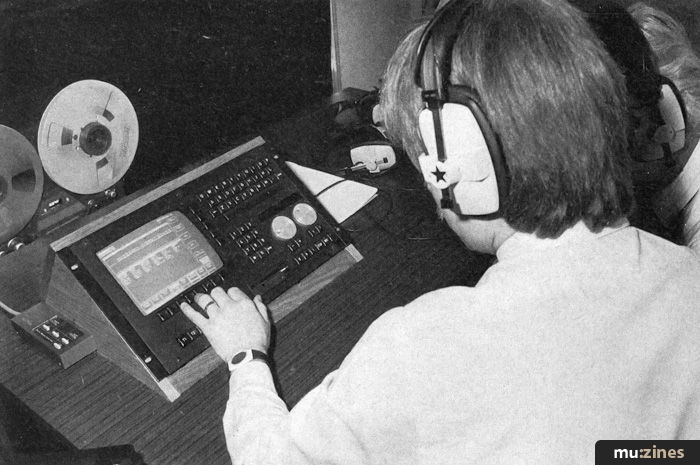
AudioFile in use: a key to one area of the company's future development
'We were determined to do something historic, in that with our knowledge of the professional aerospace industry it was easier for us to put the right components and the right quality of electronics in a product and have it work rather than have it go wrong. All along the line one of our priorities, which was not the priority of every manufacturer, was that it was cheaper to make things work than to cut corners. So our stuff always contains a lot of electronics, all in there for the reason that they work well and for no other reason.
'It was all done on the principle that it would give us an easier life than to have to have somebody belting up and down the motorway in a Cortina servicing products that we'd sold to London. And that's stuck. That's behind all our products.
'And another thing we were determined about was that if we were charging what we considered a reasonable amount of money, we would not let people be disappointed in what they bought. You just try and find a secondhand bit of AMS kit. They're still as valuable now as ever.
'I think we have fulfilled the desires we had in the early days which were "let's make a piece of gear; let's make it exciting; and let's make it something everybody wants."
'Part of the healthy enthusiasm that exists in AMS is down to knowing damn well that Phil Collins uses our reverb programmes; that Peter Gabriel will use our pitch changer right up with his lead vocal; that Paul McCartney will use our products on his film soundtracks. And we know that if they have any comments, or suggestions or requests we'll try and help. We do our damnedest to react to anything anybody says in terms of modifying or improving our products.
'It's nice that you can bump into Bob Clearmountain in New York and he'll bend your ear for hours about how he's used AMS products on David Bowie albums, and how the American end of Live Aid only used one snare sound, which was Mel Gaynor's from Simple Minds, triggered from an AMS. All that's brilliant. And that's what motivates us.
'We're not the sort of people who want to walk into a factory on a Monday morning and pull a handle and have 30,000 digital reverbs drop off the other end of a production line, to go winging their way all over the globe.
'That's not our interest. Our interest is serving the professional, interfacing with the professional and giving them what they want.
'And it works.'
More with this topic
 |
 The Power of Wind - Nyle Steiner and Sal Gallina Interviewed |
 Inside Views: J L Cooper |
 Who Did It First? |
 Gibson Vs. The Future. - The Gibson Direction |
 The Ins and Outs of Digital Design |
 Butcher, Baker, Album Cover Maker - OR: HOW A GENESIS LP SLEEVE IS MADE |
 The Search For Expression - A History of Wind Synthesizers |
 Go East Young Band - Roland Report |
 Analogue Equipment Design - for Rock 'n' Roll (Part 1) |
 Company Report - Sequential |
 The Making Of A Guitar - Bourne Dragoner |
Browse by Topic:
Design, Development & Manufacture
Publisher: Sound Engineer and Producer - Media Week Ltd.
The current copyright owner/s of this content may differ from the originally published copyright notice.
More details on copyright ownership...

Sound Engineer and Producer - Nov 1986
Donated by: James Perrett
Feature by Chris Maillard
Help Support The Things You Love
mu:zines is the result of thousands of hours of effort, and will require many thousands more going forward to reach our goals of getting all this content online.
If you value this resource, you can support this project - it really helps!
Donations for August 2026
Issues donated this month: 0
New issues that have been donated or scanned for us this month.
Funds donated this month: £0.00
All donations and support are gratefully appreciated - thank you.
Magazines Needed - Can You Help?
Do you have any of these magazine issues?
If so, and you can donate, lend or scan them to help complete our archive, please get in touch via the Contribute page - thanks!
Please Contribute to mu:zines by supplying magazines, scanning or donating funds. Thanks!
Monetary donations go towards site running costs, and the occasional coffee for me if there's anything left over!

 @mu_zines
 RSS Feed
 Blog
Blog