


Magazine Archive
Home -> Magazines -> Issues -> Articles in this issue -> View
Article Group: | |
Talking Dirty | |
Article from International Musician & Recording World, June 1986 | |
Everything you wanted to know about distortion
Mark Wood takes a look at how things have been, are, and can be distorted. Effects pedals for guitarists have come a long way since the days of the dear old fuzz and wah-wah.

The early Seventies saw the advent of the whooshing phaser which, in turn, begat the whooshing flanger, and the adventurous guitarist of that era might also have invested in a rather Heath Robinson device called an echo unit. These effects might have been noisy, voracious consumers of batteries, but they opened up new areas of expression for the guitarist. After all it was the sound that mattered.
By the mid-Seventies, however, a new age of effects pedal had appeared, largely heralded by the arrival of the BOSS CE1 CHORUS pedal. This was the nearest the guitarist had come to a studio quality stage effect.
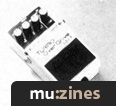
But what happened to the fuzz pedal – the first real guitar effect? Well, for a start it's no longer called a fuzz pedal. From those single cell origins it's multiplied into a species of its own. So now we have overdrive pedals, distortion pedals, heavy metal pedals and compressor sustainers. Confused? The guitarist of fifteen years ago would have been.
However bewildering the choice may seem, it's important to point out that the proliferation of distortion pedals on the market today is not just an attempt to market baked beans in different shaped cans. Each pedal has a sound and characteristic of its own. So let's look at the way the BOSS range of distortion pedals differ from one to another in sound character, features and application.

Boss currently offer the guitar player five dedicated distortion pedals. The DS1 DISTORTION is probably the simplest of all five pedals. The distortion knob controls the sustain time as well as the amount of distortion required. Set fairly low, it simulates the soft clipping of an overdriven amplifier, providing a discreet but discernible crunch to rhythm playing. The tone control boosts the lower frequencies when turned anticlockwise, and when turned clockwise, the higher frequencies are accentuated. The level control acts as a master volume for the effect.
These three controls are also common to the DF2 SUPER FEEDBACKER & DISTORTION. This is an ingenious distortion pedal which allows the guitarist to simulate feedback at any volume. In essence it's a similar pedal to the DS1 in terms of distortion, although tonally, it does sound a little smoother in the midrange frequencies. However, the big difference between the two pedals is the feedback function. Here's how it works.

By pressing the pedal once, the distortion effect is engaged – just like any other pedal. But press the pedal again and as long as you keep the pedal depressed an oscillator inside the DF2 will sustain the last note played on the guitar. You can fine tune the note the oscillator produces by adjusting the overtone control. The range of this control is from unison to an octave above the guitar. However some interesting sounds are possible when the overtone is set to give a blend of octave and unison. An added bonus with the DF2 is that it's no longer necessary to hold the note on the guitar once the feedback circuit is engaged, leaving both hands free to gesticulate wildly to the audience!
There are two main differences between the SD1 SUPER OVERDRIVE and the DS1 DISTORTION. Firstly, the SD1 tends to emphasise the midrange frequencies more prominently, resulting in a thicker overall sound, more akin to a tube amplifier. Secondly, it responds to the dynamics of the guitarist's playing style, particularly when the drive control is set low. The SD1 is also very responsive to tone and volume changes on the guitar itself.

Whilst sharing the same level, tone and drive controls as the SD1, the OD2 also boasts a fourth gear – the TURBO factor! The TURBO switch produces a dramatic increase in sustain and distortion yet still manages to let the guitarist play with dynamic control. This is one of the smoothest sounding overdrive pedals I have played and I was also surprised at its ability to handle certain chords outside of the usual power chord domain. One other notable feature of the OD2 is its lack of noise, even at high gain settings which would have many other overdrive units squealing in protest.
Last of the distortion pedals to come under the microscope is the celebrated HM2 HEAVY METAL pedal: a wolf in wolf's clothing! However, despite offering degrees of distortion ranging from mild to indecent, the HM2 always remains touch sensitive. A further refinement is the provision of a two band EQ circuit. This enables the guitarist to emphasize different harmonics and create the illusion of a large amp driven close to the limit!
Although not a distortion pedal, the CS2 COMPRESSOR SUSTAINER is an intrinsic part of many guitarist's effects systems. This is due to its ability to increase sustain, induce feedback, act as a preamp and control the overall volume; simultaneously! It can act as a limiter to control errant transient peaks in certain rhythm parts and will add sustain to non-distorted guitar sounds. Every guitarist who uses a compressor finds a special use for it, and if restricted to just one pedal, this is the one I would choose.
All the effects I've discussed are normally associated with guitar, but there is enormous potential for their use with synthesizers. I frequently process the GR700 guitar synthesizer through the HM2 Heavy Metal for some really savage lead sounds and I know keyboard players who perform similarly perverse surgery with effects on synthesizers. Solo violin and cello sounds can be treated to give the effect of a bow scraping across the strings, and horn and flute sounds can be made breathy by applying a judicious amount of distortion. Drum machines can also benefit from the use of distortion. Snare drums and hand claps take on a bizarre industrial flavour, and even shakers and neutral sounding rimshots respond to the treatment.
There are many other pedals in the BOSS range that can enhance these distortion effects. The GE7 GRAPHIC EQUALIZER, for example, could almost be seen as a distortion device if used as a preamp to overdrive the amplifier itself. Try putting an OC2 OCTAVE PEDAL between a CS2 COMPRESSOR and any of the distortion units already mentioned and the guitar will become almost like a synthesizer – a great way to double bass lines. Experiment with a VB2 VIBRATO to make power chords shimmer, or place it after the DF2 pedal in order to modulate the feedback effect.
More from these topics
 Where Are They Now? - Roland Demonstrators make Good! |
 Widen your horizons - FX tutorial (Part 1) |
 Perfect Timing |
 SRV-2000 - A Computer Reverb |
 Reverberation |
HS-60 - The Synth With Everything |
 Sound Bites - Production Tips & Techniques |
 The Boss Micro Rack |
 Back to Back |
When is EQ |
 SDE-2500. The memories linger on |
 TR-707 - The Record Maker |
Browse by Topic:
Advertisement Feature
Effects Processing
Publisher: International Musician & Recording World - Cover Publications Ltd, Northern & Shell Ltd.
The current copyright owner/s of this content may differ from the originally published copyright notice.
More details on copyright ownership...

International Musician - Jun 1986
Roland Newslink - Summer 86
Feature by Mark Wood
Help Support The Things You Love
mu:zines is the result of thousands of hours of effort, and will require many thousands more going forward to reach our goals of getting all this content online.
If you value this resource, you can support this project - it really helps!
Donations for May 2026
Issues donated this month: 0
New issues that have been donated or scanned for us this month.
Funds donated this month: £0.00
All donations and support are gratefully appreciated - thank you.
Magazines Needed - Can You Help?
Do you have any of these magazine issues?
If so, and you can donate, lend or scan them to help complete our archive, please get in touch via the Contribute page - thanks!
Please Contribute to mu:zines by supplying magazines, scanning or donating funds. Thanks!
Monetary donations go towards site running costs, and the occasional coffee for me if there's anything left over!

 @mu_zines
 RSS Feed
 Blog
Blog