


Magazine Archive
Home -> Magazines -> Issues -> Articles in this issue -> View
Premier 'Prolock' Hardware | |
Article from In Tune, May 1986 | |
As a follow-on to this month's look at Premier, leading UK drummer Charlie Morgan (currently on tour with Elton John) joins the IN TUNE All-Stars team, and checks out Premier's latest hardware innovations.
In the past, the name Premier has been synonymous with that particularly British ailment, complacency. Branded as unadventurous and old-fashioned, with products which were uninnovative, the company began the 1980s with severe financial difficulties, made worse by an increasingly aggressive marketing policy among competitors, particularly from the Far East. This led eventually to the Receiver being called in - an alarmingly regular occurrence in these difficult economic times (see our Premier report -Ed.). However, this is where the Premier story departs from the usual tales of liquidation and bankruptcy, starting with a daring rescue bid by key members of the ailing company's management. Premier Percussion's struggle to succeed in the dog-eat-dog atmosphere of the 1980s is a lesson to all British companies. Premier's ability to manufacture quality percussion instruments and accessories had never once been in doubt. In fact the company was unique in having its own manufacturing plants, thus not needing to rely on outside suppliers meeting deadlines, as well as being able to closely monitor the quality of their products. Armed with this obvious asset, the management set about re-thinking a lot of the outdated research and marketing strategies; in particular the design of kit accessories such as tom-tom holders, cymbal stands, hi-hat pedals and snare drum stands.
In 1980 when I first started using Premier drums, I bought a Resonator kit (which, incidentally, has given me hundreds of hours of faithful service). The drums themselves were even then better made and better finished than just about any other drums on the market, but the stands just couldn't live up to the same expectations. True, they were beautifully made; but the designs were cumbersome and ill thought-out, as well as unattractive to the vast majority of the buying public. So I ended up using accessories made by one of Premier's Japanese rivals.
This has now all changed - and very much for the better, I might add. I recently took delivery of a shiny new Black Shadow kit which included a complete set of the latest Prolock accessories. A great deal of thought has been put into the 'flagship' of Premier's range. All the legs are double braced tripod design, with sturdy rivet-work and a satisfying, smooth action. There is a choice of three cymbal stands; one straight stand, one boom stand, and a short boom stand with a disappearing boom which enables it to double as a straight stand if needed. The tops of the cymbal stands have a small section of unthreaded rod, to prevent the cymbal nuts flying off when packing up - something which I've found particularly useful! The top-of-the-range snare stand is a 'triple claw action' type which holds the snare drum in a vicelike grip. This cradle is attached to the base by an off-centre pivot, which enables an almost infinite amount of adjustment. The hi-hat stand offers a degree of height adjustment hitherto only seen in the halcyon days of the old Rogers pedals (one of my early favourites). The two adjustable outboard tension springs have lock-nuts to enable permanent memorising of the perfect hi-hat feel.
The most revolutionary feature of all these stands, however, is the method of height adjustment. This is the 'Prolock' from which the range derives its name, and it consists of a square-head tension nut set in a sturdy 'knuckle' (or ferrule, as Premier call it) and tightening on to a hard plastic insert. This in itself is fairly standard in the world of drum stands, but the ingenious part is the addition of a wing nut on the side of the ferrule which, when undone, releases the ferrule together with with the section of stand (still held in place by the square nut), allowing the stand to be broken down and reassembled to exactly the same position every time. Where this wins against other 'memory-lock' devices is that not only is height memorised, but also the position of the top of the stand relative to the bottom of the stand. When you have to fit all the stands round a kit in as short a time as possible, the advantages become apparent!
Tom-tom holders have also come under the scrutiny of Research and Development recently, although the idea employed isn't such a new one. The new 'Fastball' system is a nylon ball held in a cast metal socket, which is certainly robust and allows considerably more adjustment than previously possible. The system also has room for the addition of either a third tom bracket or a cymbal arm on to the existing holder, yet again saving space on the ground around the kit.
Whilst on the subject of saving floor space, Premier have released an add-on bracket, known as a 'Multi-Clamp', which can be attached securely to any stand and allows you to position a number of items, such as extra cymbal arms, cowbell clamps, etc., without taking up any floor space. Theoretically, with two Prolock tom-tom stands, a couple of cymbal tops and a brace of multi-clamps, you would only need a couple of stand bases for the average kit - although I'm not so sure it's a good idea to put too many extra bits on to a bass drum mounted tom-tom stand, for obvious reasons!
To complement the new range of stands, Premier continue to make a good range of excellent bass drum pedals, to fit all styles of playing, and most budgets.
For further details, contact Premier Percussion Ltd., (Contact Details).
Products mentioned are:
- Prolock Straight Cymbal Stand - RRP £51.45.
- Prolock Boom Stand (with counterweight) - RRP £60.45.
- Prolock Disappearing Boom Stand - RRP £62.55.
- Snare Stand with offset cradle (claw action) - RRP £54.10.
- Hi-Hat with twin external tension springs - RRP £75.30.
- Prolock Double Tom-Tom Holder (price on application).
- Bass Drum pedal - RRP £39.
Publisher: In Tune - Moving Music Ltd.
The current copyright owner/s of this content may differ from the originally published copyright notice.
More details on copyright ownership...
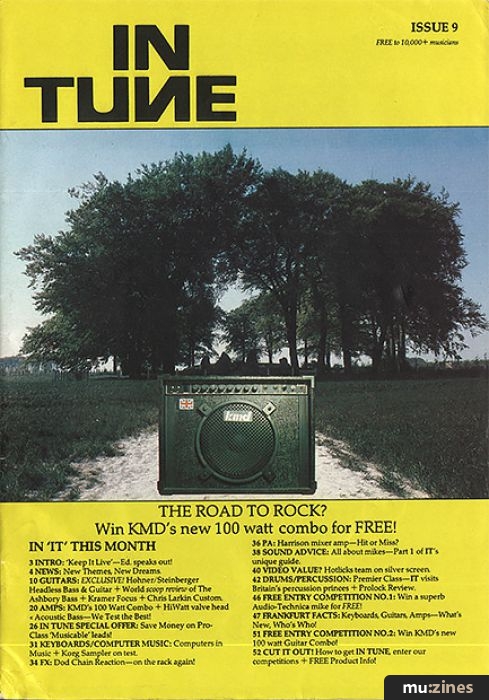
In Tune - May 1986
Review by Charlie Morgan
Previous article in this issue:
Next article in this issue:
Help Support The Things You Love
mu:zines is the result of thousands of hours of effort, and will require many thousands more going forward to reach our goals of getting all this content online.
If you value this resource, you can support this project - it really helps!
Donations for June 2026
Issues donated this month: 0
New issues that have been donated or scanned for us this month.
Funds donated this month: £0.00
All donations and support are gratefully appreciated - thank you.
Magazines Needed - Can You Help?
Do you have any of these magazine issues?
If so, and you can donate, lend or scan them to help complete our archive, please get in touch via the Contribute page - thanks!
Please Contribute to mu:zines by supplying magazines, scanning or donating funds. Thanks!
Monetary donations go towards site running costs, and the occasional coffee for me if there's anything left over!

 @mu_zines
 RSS Feed
 Blog
Blog