
Magazine Archive
Home -> Magazines -> Issues -> Articles in this issue -> View
Millioniser 2000 | |
SynthcheckArticle from International Musician & Recording World, March 1985 | |
The most revolutionary instrument since the Stylophone. Review by Curtis Schwartz
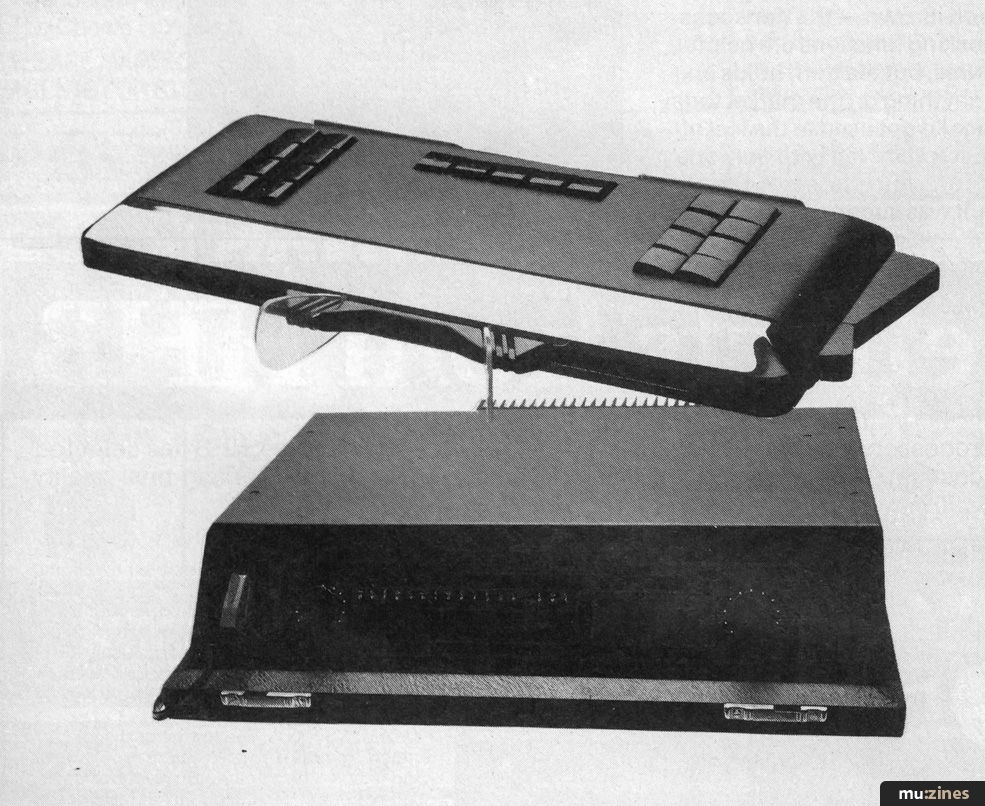
Despite having a very unconventional name, unconventional design with an unconventional approach; the Millioniser 2000 is a fairly ordinary item really.
To be more precise, this 'item' is a monophonic, programmable, touch (or rather breath) sensitive, three oscillator, analogue synthesizer/harmonica. And you thought you'd heard everything...
To start at the end (?), let me simply say that the Millioniser 2000 sounds great, works great, and looks... well, unconventional. With only a breath controller from which to control/play the synthesizer, a first reaction from all you conventional finger musicians might be to think of it as being an instrument simply for wind musicians. I should point out that this is most certainly not the case — I, like most people, have at one time or another attempted to master the old Blues harp. I found that it was not too easy, and I soon lost interest. However, after only 10 minutes with the Millioniser, I was playing the simplest of synth lines with ease — you know the Depeche Mode/Human League variety. Just think what you could achieve in a whole afternoon...
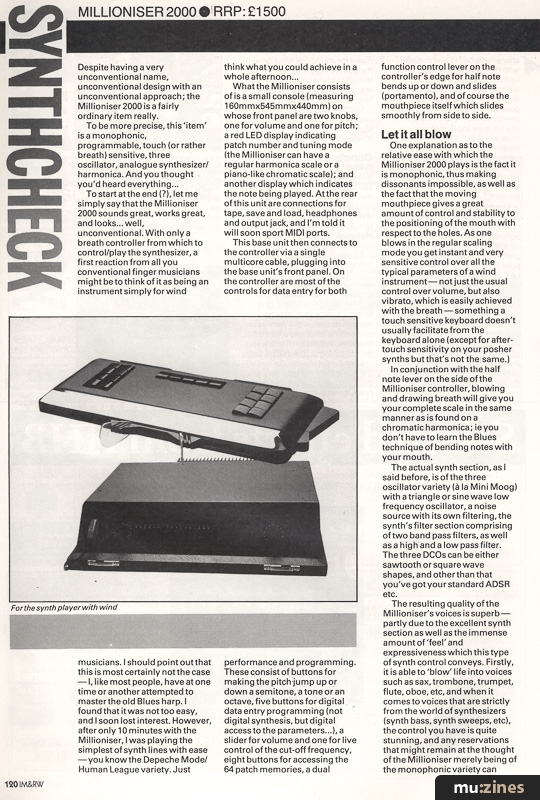
What the Millioniser consists of is a small console (measuring 160mm x 545mm x 440mm) on whose front panel are two knobs, one for volume and one for pitch; a red LED display indicating patch number and tuning mode (the Millioniser can have a regular harmonica scale or a piano-like chromatic scale); and another display which indicates the note being played. At the rear of this unit are connections for tape, save and load, headphones and output jack, and I'm told it will soon sport MIDI ports.
This base unit then connects to the controller via a single multicore cable, plugging into the base unit's front panel. On the controller are most of the controls for data entry for both performance and programming. These consist of buttons for making the pitch jump up or down a semitone, a tone or an octave, five buttons for digital data entry programming (not digital synthesis, but digital access to the parameters... ), a slider for volume and one for live control of the cut-off frequency, eight buttons for accessing the 64 patch memories, a dual function control lever on the controller's edge for half note bends up or down and slides (portamento), and of course the mouthpiece itself which slides smoothly from side to side.
Let it all blow
One explanation as to the relative ease with which the Millioniser 2000 plays is the fact it is monophonic, thus making dissonants impossible, as well as the fact that the moving mouthpiece gives a great amount of control and stability to the positioning of the mouth with respect to the holes. As one blows in the regular scaling mode you get instant and very sensitive control overall the typical parameters of a wind instrument — not just the usual control over volume, but also vibrato, which is easily achieved with the breath — something a touch sensitive keyboard doesn't usually facilitate from the keyboard alone (except for aftertouch sensitivity on your posher synths but that's not the same.)
In conjunction with the half note lever on the side of the Millioniser controller, blowing and drawing breath will give you your complete scale in the same manner as is found on a chromatic harmonica; ie you don't have to learn the Blues technique of bending notes with your mouth.
The actual synth section, as I said before, is of the three oscillator variety (à la Mini Moog) with a triangle or sine wave low frequency oscillator, a noise source with its own filtering, the synth's filter section comprising of two band pass filters, as well as a high and a low pass filter. The three DCOs can be either sawtooth or square wave shapes, and other than that you've got your standard ADSR etc.
The resulting quality of the Millioniser's voices is superb — partly due to the excellent synth section as well as the immense amount of 'feel' and expressiveness which this type of synth control conveys. Firstly, it is able to 'blow' life into voices such as sax, trombone, trumpet, flute, oboe, etc, and when it comes to voices that are strictly from the world of synthesizers (synth bass, synth sweeps, etc), the control you have is quite stunning, and any reservations that might remain at the thought of the Millioniser merely being of the monophonic variety can instantly be dispersed — especially in this age of multitracking.
For the technical minds among you who are curious as to the internal workings of the breath controller, it merely works on the principle of photosensitive cells transmitting the information via the pressure sensitive circuit in the handset to the main synth controller. This simplest yet effective system is also employed in the medical profession to transmit information from physically handicapped persons to electronic destinations — wheelchair motors, etc.
As is the current vogue for synthesizer layout in general (the use of a single synth controller on stage, and the rest of the hardware — modular synths, MIDI DDLs, etc — being stacked out of the way among the backline) the Millioniser's design of having the small mouthpiece from which to play and control the synth parameters is a good choice on their behalf. No doubt when the polyphonic MIDI version appears later this year, the necessary centre-of-stage gear will be further reduced — in theory at least.
Conclusion
After a few false starts from several synth manufacturers to convert 'blowers' to the world of synthesis — the poor old Lyricon for example — the Millioniser people appear to have hit the proverbial nail on the head, avoiding the pitfalls which befell similar attempts, and achieving its goal with infinitely more musicality than even they might have anticipated. On the merits of its ability to transmit every nuance of the performance, I give it full marks. Similarly it deserves flying colours for tonal versatility, design, and useability. However, the only hesitation that I have is regarding the instrument's price. Although a final price has yet to be decided, I have been led to believe by the manufacturers that not only will it be on the wrong side of a thousand pounds, but it also looks to be creeping more towards the two thousand pound mark than was first hoped. If this is in fact the case, then despite 28 million Hohner harmonicas having been sold last year, I think only a microscopic percentage of those people will be spending two grand on such an instrument.
Even so, the Millioniser people are working on a budget version as well as the previously mentioned polyphonic version. I hope that the budget one appears soon and I, for one, wish them luck — at two grand a hot they're going to need it.
For further details contact Rick Davey, Millioniser 2000 Ltd, (Contact Details).
Publisher: International Musician & Recording World - Cover Publications Ltd, Northern & Shell Ltd.
The current copyright owner/s of this content may differ from the originally published copyright notice.
More details on copyright ownership...

International Musician - Mar 1985
Donated & scanned by: Mike Gorman
Gear in this article:
Review by Curtis Schwartz
Help Support The Things You Love
mu:zines is the result of thousands of hours of effort, and will require many thousands more going forward to reach our goals of getting all this content online.
If you value this resource, you can support this project - it really helps!
Donations for June 2026
Issues donated this month: 0
New issues that have been donated or scanned for us this month.
Funds donated this month: £0.00
All donations and support are gratefully appreciated - thank you.
Magazines Needed - Can You Help?
Do you have any of these magazine issues?
If so, and you can donate, lend or scan them to help complete our archive, please get in touch via the Contribute page - thanks!
If you're enjoying the site, please consider supporting me to help build this archive...
...with a one time Donation, or a recurring Donation of just £2 a month. It really helps - thank you!

 @mu_zines
 RSS Feed
 Blog
Blog