


Magazine Archive
Home -> Magazines -> Issues -> Articles in this issue -> View
Ludwig Sound Projector | |
DrumsArticle from Sound International, May 1979 | |

Ludwig is one of the most respected makes among drummers throughout the world and since the tariffs in this country were lifted in the 1950s they have been a good selling choice of drums for the pro.
The Ludwig drum factory was started by William F and Theobald R Ludwig in 1909 in a small barn on the west side of Chicago. The Ludwig drum company have been responsible for many innovations in the drum world, like the separate tension snare drum and some of the most successful bass drum pedals, among other things.
More recently Ludwig have come in for a bit of criticism regarding a drop in shell and chrome quality between the years of 1968 and 1977. This could have been put down to any number of things at the factory, but I am led to understand that because of a vastly increasing demand, and installation of new machinery and mass production, Ludwig's high reputation began to lag a little.
The Japanese are producing such good quality drums and fittings these days that most likely Ludwig Industries decided to reaffirm their high position in the drum sales market and have brought out a whole new range of shells and stands which I am glad to say are very impressive in quality, looks and sound. The new shells on Ludwig drums are 6-ply on the wood kits, joined in three different locations to avoid overlaps or humps, and these plys are then joined to a near seamless configuration in Ludwig's diemould process.
Ludwig also make stainless steel and vistalite shells which are an acquired taste, and I think that they look better than they sound, but in this review the kit in question is genuine 6-ply tree wood.
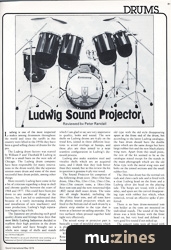
The Sound Projector kit comprises of the following drum sizes: 24in x 16in bass drum, 10in x 9in, 12in x 11in, 13in x 12in, 14in x 13in concert toms, a 18in x 16in floor tom tom and the now renowned 6½in (402) metal shell snare drum. The toms are all single headed, including the 18in x 16in floor tom, and all toms have the plastic sound projectors which are fixed to the bottom end of each drum by a plastic strip similar to the type that is worn as a fastener on sailing anoraks. The two surfaces when pressed together hold tight very effectively.
The actual scoop or projector part is basically a type of moulded plastic which is pliable and therefore would be very difficult to break.
When I reviewed this kit at the London Rose-Morris showroom in Shaftesbury Avenue, the bass drum seemed to be the old type with the old style disappearing spurs at the front end of the drum, but according to the latest Ludwig catalogue, the bass drum should have the double spurs which are the same design but have large rubber feet and the new black plastic wing nuts. Apart from this small point, the rest of the kit seemed to be as the catalogue stated except for the stands in the main photograph which are the old Atlas type with the metal wing nuts and bolts on the joined sections and the small rubber feet.
The 24in bass drum has the normal ten rods and claws each side and is fitted with a clear Ludwig head on the front and a Ludwig silver dot head on the playing side. The hoops are wood, with a silver inlay, and spurs are the curved disappearing type with rubber feet which, when removed, reveal an effective spike if preferred.
There is no bass drum-mounted tom tom holder as the toms are mounted on individual stands. The sound of the bass drum was a little boomy with the front head on, but very loud and defined — a very good live sound if not miked up.
The concert toms were all fitted with Ludwig BD1000 silver dot heads and had no dampers as is normal with concert toms. All four concert toms were mounted on floor-standing concert tom stands which does restrict the playing angle somewhat as these stands only adjust forwards, backwards, up and down. So if you are not used to playing all toms level with each other, then tough! I would have preferred a stand like the Ludwig double tom tom floor stand which would give more alternative playing angles according to individual taste. Tama made this mistake with their concert tom stands and have since fitted all their concert toms with the compatible holder for a double floor stand.
The 18in floor tom has the usual unchanged leg brackets which are one of the most practical designs and work well. Similar to other makes such as Pearl, Tama or Premier, they work on the principle of the leg going through an eyebolt inside the bracket which is then tightened by a wing nut thus pulling the eye hole into a small groove inside the bracket.
The floor tom also has the sound projector on the bottom end of the shell which is, of course, open-ended as with the rest of the toms; it has silver spot heads and triple flange rims. The three legs had small rubber feet which performed well enough although they seemed unusually small compared with the large rubber feet that abound on the stands.
The floor tom also has a small damper fitted which is adjusted up or down by turning a round knob at the side of the drum. The felt damper is about 2in across and works fine if you like that sort of thing. I am personally against internal dampers because they tend to distort the head and ruin a perfectly good drum sound by cutting out the tone as well as the ring, but that's another story!
The sound of the toms with projectors on seems to be not only a bit louder but more directional going from right to left as you are standing in front of the kit when it is being played. This stereo effect is not so apparent when the projectors are taken off and in a sense the idea reminds me of the North drums that appeared over here about a year ago. The overall sound of the toms was very pleasing with a clear defined sound to each one. The Ludwig silver spot heads are ideal for this type of drum as they are responsive but give a decent thud without too much ring.
The 402 Ludwig snare drum which is supplied with this kit is probably my favourite snare drum and, having owned one of these drums for about three years, I have yet to find a snare drum to match this for sound and I think I have tried all the popular makes. The 400 snare drum which is the 14in x 5in model has for years now been the best all-round snare drum, but as the need for deeper sounds in the snare department are more the vogue the 402 6½in could take over as the world's most popular snare drum. The rims are, of course, triple flange and the drum comes fitted with silver spot heads and 18-strand wire snares. As with the toms, the tension rods are 7/32in Whitworth square-headed type and have small washers between rod and rim to stop slip.
The shell is all metal made, of one piece seamless construction with a centre bead and flanged kettle edge. The snare strainer called the P85 is the throw-off type which is very simple and effective. A fine adjustment control knob maximises snare tension and eliminates choke. On the 402 everything seems well thought out and simple and, of course, has a really good sound (this is not always the case if tuned badly).
If you have just purchased one of these drums, you will probably find you discover that really typical deep Ludwig snare sound by accident. When I first purchased mine, I could not understand what all the fuss was about and it took me about three weeks to actually get a really fantastic sound.
Despite all this praise, the drum does tend to de-tune after a few hours of heavy playing and so it needs to be checked periodically for tension.
The hardware on this kit is Ludwig's new line called the Hercules stands. The main difference between the Hercules and the very popular Atlas range is the tubular legs, large rubber feet and large plastic wing bolts on movable parts. All the Hercules stands are comparatively light in weight considering their size and heavy duty construction.
The hi-hat has a direct pull action with a variable spring tension adjustment knob with a Lexan connection link which is a type of toughened plastic which also contributes to action. There are two spurs, one under the heel plate (which is a two-piece cast foot plate) and an adjustable one in the bottom of the twin post assembly framework. There is a new type of hi-hat clutch with a large wing-nut on the bottom and a very large locking nut on top with a large 'T' bolt arrester.
The legs are the tubular tripod type with thick down tubes. Other than this the basic design is very similar to the Atlas stand that has been one of Ludwig's top selling lines. The snare drum stand also has the tubular tripod legs and the familiar Buck Rodgers style basket mechanism. No earth-shattering changes here but a very neat, light, well-designed stand which folds up easily and holds the snare drum securely.
Looking closely at these large plastic wing bolts, which are fitted to all the stands, I feel a little uneasy about praising them too highly as there could be problems with these if over-tightened. I have not seen any split or break yet but it is early days, so let's see what happens in a year's time when these stands have had time to be abused a little bit.
The concert tom stands, again with large rubber feet and tubular construction, hold two drums each by means of a slot-on bracket with a hard felt ball separator to keep the drums apart and stop rattle. The ball also protects the shell from damage. The concert tom stands performed their job well and were very sturdy but, as I mentioned earlier, I was very disappointed with the lack of adjustments.
The two boom cymbal stands had the same tubular design with large rubber feet, plastic wing bolts, etc, and felt very light in weight, and had no counterweight at the end of the boom arm. This seems to me to be an important oversight as, while it felt reasonably steady with a 16in crash, when I placed a 20in medium ride cymbal and extended the boom arm over the toms, it felt very unsteady indeed. I will personally give this one a miss although it does look nice.
If you are a drummer and reading this review, you are probably reasonably aware of what is available in the bass drum pedal market, and it must also mean you know the Ludwig Speed King bass drum pedal even if you have never actually owned one. This brings me to probably the best-known, tried and tested, loved or hated, bass drum pedal available today. This pedal in its virgin form first saw light of day in 1937 and is a twin compression spring two-piece reversible heel plate model with spring adjustment via the base of the twin posts. Being a compression spring, the return of the beater is very fast and is aptly named for this quality. The metal connecting link is very strong and is usually the last thing to break. In fact it is more likely you will wear the metal connecting link out or break the cast metal footplate. The cast rocker assembly which retains the beater has been known to fracture and the actual ball bearings sealed inside the post caps do tend to squeak periodically and so need lubricating now and then.
I have made a few criticisms of this kit and accessories but generally I feel this is a worthwhile investment if you want a good stage kit. It looks good, sounds great, and you could spend just over a grand on a few other kits which would not match up to this one. The good points, I am glad to say, outweigh the bad points. The kit reviewed was plain black with black sound projectors. There is a choice of different coloured sound projectors to match the colour of your kit — even perspex.
Ludwig is marketed in the UK by Rose-Morris.
rrp: £974.07/$2297.
Peter Randall is an ex-pro drummer now working as a salesman at Henrit's Drumstore in Central London.
Publisher: Sound International - Link House Publications
The current copyright owner/s of this content may differ from the originally published copyright notice.
More details on copyright ownership...

Sound International - May 1979
Donated by: Richard Elen
Gear in this article:
Review by Peter Randall
Help Support The Things You Love
mu:zines is the result of thousands of hours of effort, and will require many thousands more going forward to reach our goals of getting all this content online.
If you value this resource, you can support this project - it really helps!
Donations for April 2026
Issues donated this month: 0
New issues that have been donated or scanned for us this month.
Funds donated this month: £0.00
All donations and support are gratefully appreciated - thank you.
Magazines Needed - Can You Help?
Do you have any of these magazine issues?
If so, and you can donate, lend or scan them to help complete our archive, please get in touch via the Contribute page - thanks!
Please Contribute to mu:zines by supplying magazines, scanning or donating funds. Thanks!
Monetary donations go towards site running costs, and the occasional coffee for me if there's anything left over!

 @mu_zines
 RSS Feed
 Blog
Blog