
Magazine Archive
Home -> Magazines -> Issues -> Articles in this issue -> View
Here's Stringz 'n' Thingz | |
Maybe we should have called it thingz 'n' stringzArticle from Polyphony, February 1978 | |
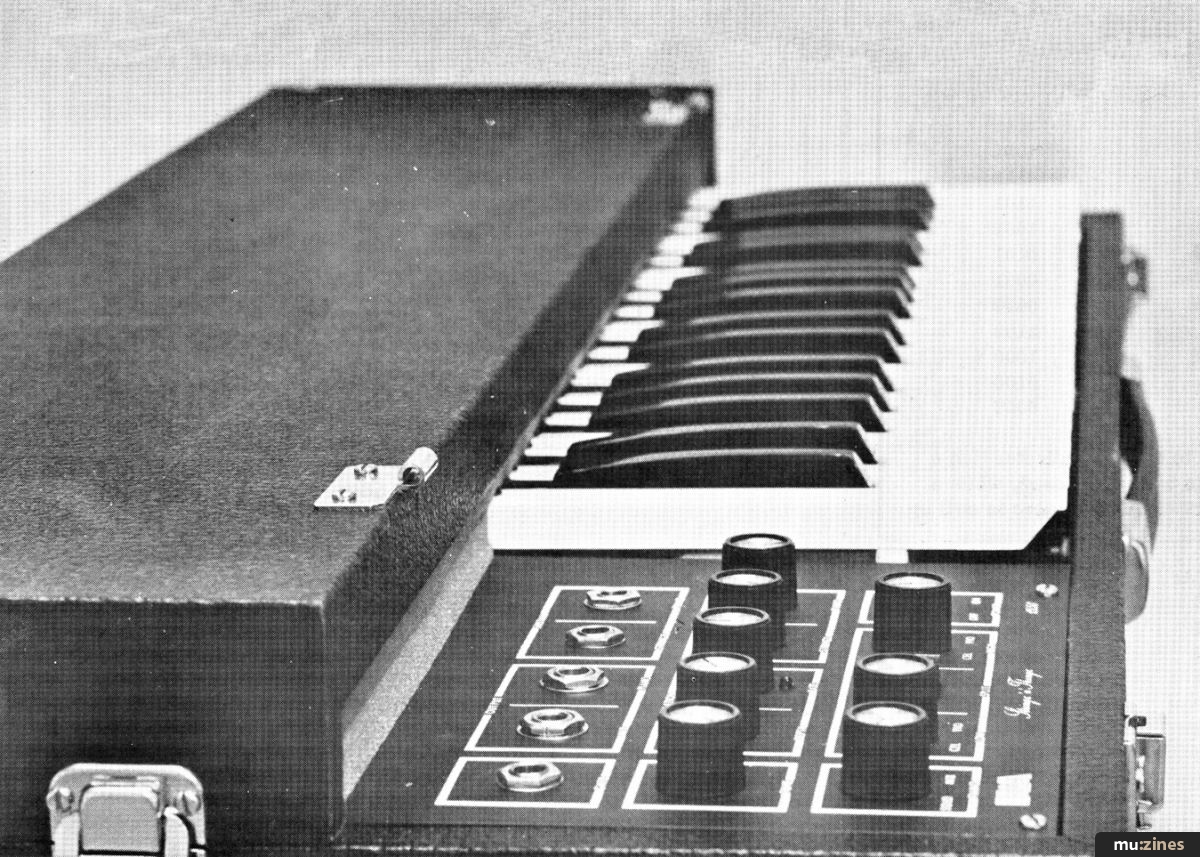
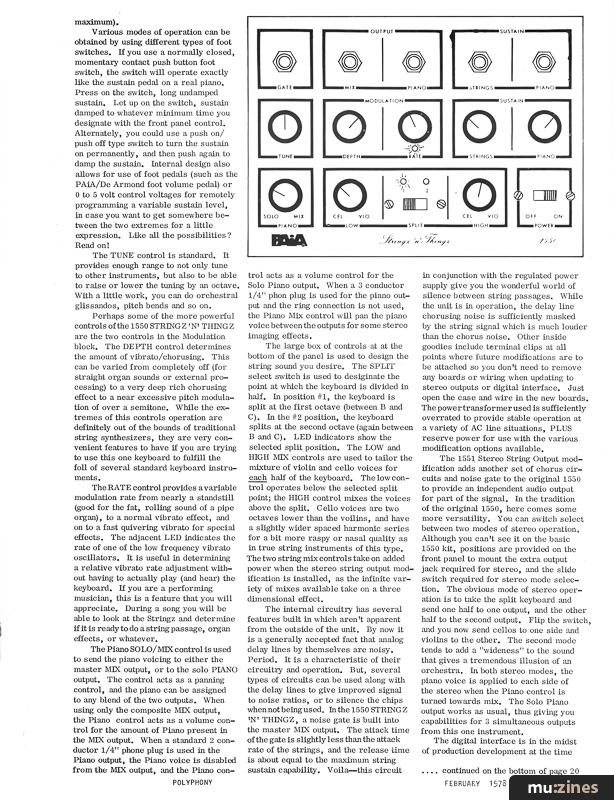
String synthesizers are pretty neat. They were one of the first "special purpose" synthesizers to come along. They represented a kind of acceptance, a kind of "growing up" of synthesizers. Strangely enough, the basic circuitry in a string synthesizer is more a development of combo organ technology than of synthesizer technology, but the rich moving sounds they produce are so powerful that most anyone (musician or not) gets a kick out of playing with them. One of the main complaints of the musicians is that the commercial units each have a slightly different sound to them, and none of them happen to sound like what they think strings should sound like... may I be the first to introduce you to STRINGZ 'N' THINGZ.
The most important part of this product is not the stringz. It's the thingz. Variable thingz. Optional thingz. Foot controlled thingz. Thingz that make this a FULLY VARIABLE string synthesizer so you can tailor the sound to fit your needs. Or even create sounds that you have been formerly using two or three extra keyboard instruments to obtain. Every effort has been made to make this instrument applicable to as many situations as possible.
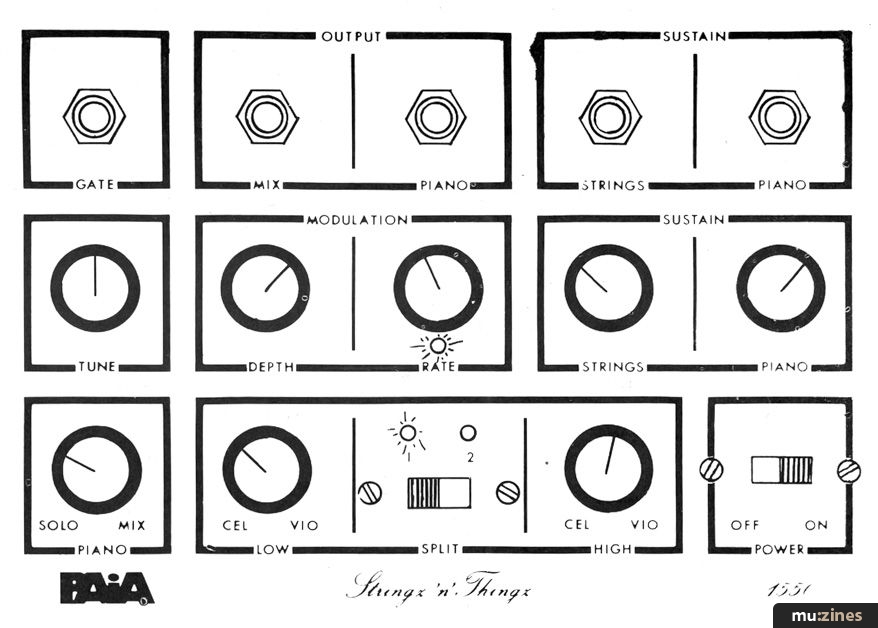
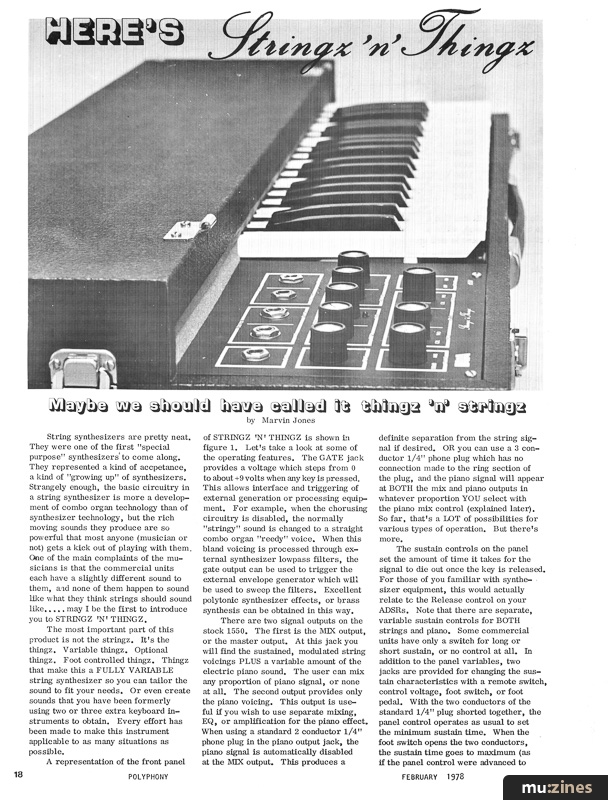
A representation of the front panel of STRINGZ 'N' THINGZ is shown in figure 1. Let's take a look at some of the operating features. The GATE jack provides a voltage which steps from 0 to about +9 volts when any key is pressed. This allows interface and triggering of external generation or processing equipment. For example, when the chorusing circuitry is disabled, the normally "stringy" sound is changed to a straight combo organ "reedy" voice. When this bland voicing is processed through external synthesizer lowpass filters, the gate output can be used to trigger the external envelope generator which will be used to sweep the filters. Excellent polytonic synthesizer effects, or brass synthesis can be obtained in this way.
There are two signal outputs on the stock 1550. The first is the MIX output, or the master output. At this jack you will find the sustained, modulated string voicings PLUS a variable amount of the electric piano sound. The user can mix any proportion of piano signal, or none at all. The second output provides only the piano voicing. This output is useful if you wish to use separate mixing, EQ, or amplification for the piano effect. When using a standard 2 conductor 1/4" phone plug in the piano output jack, the piano signal is automatically disabled at the MIX output. This produces a definite separation from the string signal if desired. OR you can use a 3 conductor 1/4" phone plug which has no connection made to the ring section of the plug, and the piano signal will appear at BOTH the mix and piano outputs in whatever proportion YOU select with the piano mix control (explained later). So far, that's a LOT of possibilities for various types of operation. But there's more.
The sustain, controls on the panel set the amount of time it takes for the signal to die out once the key is released. For those of you familiar with synthesizer equipment, this would actually relate to the Release control on your ADSRs. Note that there are separate, variable sustain controls for BOTH strings and piano. Some commercial units have only a switch for long or short sustain, or no control at all. In addition to the panel variables, two jacks are provided for changing the sustain characteristics with a remote switch, control voltage, foot switch, or foot pedal. With the two conductors of the standard 1/4" plug shorted together, the panel control operates as usual to set the minimum sustain time. When the foot switch opens the two conductors, the sustain time goes to maximum (as if the panel control were advanced to maximum).
Various modes of operation can be obtained by using different types of foot switches. If you use a normally closed, momentary contact push button foot switch, the switch will operate exactly like the sustain pedal on a real piano. Press on the switch, long undamped sustain. Let up on the switch, sustain damped to whatever minimum time you designate with the front panel control. Alternately, you could use a push on/push off type switch to turn the sustain on permanently, and then push again to damp the sustain. Internal design also allows for use of foot pedals (such as the PAiA/De Armond foot volume pedal) or 0 to 5 volt control voltages for remotely programming a variable sustain level, in case you want to get somewhere between the two extremes for a little expression. Like all the possibilities? Read on!
The TUNE control is standard. It provides enough range to not only tune to other instruments, but also to be able to raise or lower the tuning by an octave. With a little work, you can do orchestral glissandos, pitch bends and so on.
Perhaps some of the more powerful controls of the 1550 STRINGZ 'N' THINGZ are the two controls in the Modulation block. The DEPTH control determines the amount of vibrato/chorusing. This can be varied from completely off (for straight organ sounds or external processing) to a very deep rich chorusing effect to a near excessive pitch modulation of over a semitone. While the extremes of this controls operation are definitely out of the bounds of traditional string synthesizers, they are very convenient features to have if you are trying to use this one keyboard to fulfill the foil of several standard keyboard instruments.
The RATE control provides a variable modulation rate from nearly a standstill (good for the fat, rolling sound of a pipe organ), to a normal vibrato effect, and on to a fast quivering vibrato for special effects. The adjacent LED indicates the rate of one of the low frequency vibrato oscillators. It is useful in determining a relative vibrato rate adjustment without having to actually play (and hear) the keyboard. If you are a performing musician, this is a feature that you will appreciate. During a song you will be able to look at the Stringz and determine if it is ready to do a string passage, organ effects, or whatever.
The Piano SOLO/MIX control is used to send the piano voicing to either the master MIX output, or to the solo PIANO output. The control acts as a panning control, and the piano can be assigned to any blend of the two outputs. When using only the composite MIX output, the Piano control acts as a volume control for the amount of Piano present in the MIX output. When a standard 2 conductor 1/4" phone plug is used in the Piano output, the Piano voice is disabled from the MIX output, and the Piano control acts as a volume control for the Solo Piano output. When a 3 conductor 1/4" phon plug is used for the piano output and the ring connection is not used, the Piano Mix control will pan the piano voice between the outputs for some stereo imaging effects.
The large box of controls at at the bottom of the panel is used to design the string sound you desire. The SPLIT select switch is used to designate the point at which the keyboard is divided in half. In position #1, the keyboard is split at the first octave (between B and C). In the #2 position, the keyboard splits at the second octave (again between B and C). LED indicators show the selected split position. The LOW and HIGH MIX controls are used to tailor the mixture of violin and cello voices for each half of the keyboard. The low control operates below the selected split point; the HIGH control mixes the voices above the split. Cello voices are two octaves lower than the veil ins, and have a slightly wider spaced harmonic series for a bit more raspy or nasal quality as in true string instruments of this type. The two string mix controls take on added power when the stereo string output modification is installed, as the infinite variety of mixes available take on a three dimensional effect.
The internal circuitry has several features built in which aren't apparent from the outside of the unit. By now it is a generally accepted fact that analog delay lines by themselves are noisy. Period. It is a characteristic of their circuitry and operation. But, several types of circuits can be used along with the delay lines to give improved signal to noise ratios, or to silence the chips when not being used. In the 1550 STRINGZ 'N' THINGZ, a noise gate is built into the master MIX output. The attack time of the gate is slightly less than the attack rate of the strings, and the release time is about equal to the maximum string sustain capability. Voila — this circuit in conjunction with the regulated power supply give you the wonderful world of silence between string passages. While the unit is in operation, the delay line chorusing noise is sufficiently masked by the string signal which is much louder than the chorus noise. Other inside goodies include terminal clips at all points where future modifications are to be attached so you don't need to remove any boards or wiring when updating to stereo outputs or digital interface. Just open the case and wire in the new boards. The power transformer used is sufficiently overrated to provide stable operation at a variety of AC line situations, PLUS reserve power for use with the various modification options available.
The 1551 Stereo String Output modification adds another set of chorus circuits and noise gate to the original 1550 to provide an independent audio output for part of the signal. In the tradition of the original 1550, here comes some more versatility. You can switch select between two modes of stereo operation. Although you can't see it on the basic 1550 kit, positions are provided on the front panel to mount the extra output jack required for stereo, and the slide switch required for stereo mode selection. The obvious mode of stereo operation is to take the split keyboard and send one half to one output, and the other half to the second output. Flip the switch, and you now send cellos to one side and violins to the other. The second mode tends to add a "wideness" to the sound that gives a tremendous illusion of an orchestra. In both stereo modes, the piano voice is applied to each side of the stereo when the Piano control is turned towards mix. The Solo Piano output works as usual, thus giving you capabilities for 3 simultaneous outputs from this one instrument.
The digital interface is in the midst of production development at the time of this writing, but it's primary features can be discussed so you'll know what to expect. Digitally encoding a keyboard which uses standard diode keying (this includes most string synthesizers, combo organs, and so on) is a fairly easy task, and once accomplished the same keyboard can be used to feed a microprocessor for purposes of composition storage or controlling a polyphonic synthesizer. Think of it — you already have a keyboard that will do stereo strings, electric piano, and can be processed externally for synthesizer-type effects. Add a circuit board and the same keyboard can control a compliment of modules to produce up to 16 voice polyphonic work.
Here's more:
Data can be fed into the string synthesizer and actually play the strings for you. You could store the string or piano parts of your composition in the memory of a microprocessor, and have the computer play your arrangements on command. At any speed you desire. In any key you desire. Even backwards if you want, and more and more...
A few of you have known for quite a while that we were working on a string synthesizer. It's been a long time. Sorry 'bout that. But, I think you'll agree that it's been worth a wait. You're gonna' love it!
Publisher: Polyphony - Polyphony Publishing Company
The current copyright owner/s of this content may differ from the originally published copyright notice.
More details on copyright ownership...

Polyphony - Feb 1978
Donated & scanned by: Mike Gorman
Gear in this article:
Feature by Marvin Jones
Previous article in this issue:
Next article in this issue:
Help Support The Things You Love
mu:zines is the result of thousands of hours of effort, and will require many thousands more going forward to reach our goals of getting all this content online.
If you value this resource, you can support this project - it really helps!
Donations for June 2026
Issues donated this month: 0
New issues that have been donated or scanned for us this month.
Funds donated this month: £0.00
All donations and support are gratefully appreciated - thank you.
Magazines Needed - Can You Help?
Do you have any of these magazine issues?
If so, and you can donate, lend or scan them to help complete our archive, please get in touch via the Contribute page - thanks!
Please Contribute to mu:zines by supplying magazines, scanning or donating funds. Thanks!
Monetary donations go towards site running costs, and the occasional coffee for me if there's anything left over!

 @mu_zines
 RSS Feed
 Blog
Blog