

Magazine Archive
Home -> Magazines -> Issues -> Articles in this issue -> View
Elka Orla EK44 digital synth | |
Article from Making Music, January 1987 | |
OPINION
We won't say that Elka Orla took a long, hard look at the Yamaha DX21 synth before opening their tool kit. We'll just say that the EK44 uses an arrangement of four oscillators, stacked in eight different patterns, to produce digital sounds uncannily like FM.
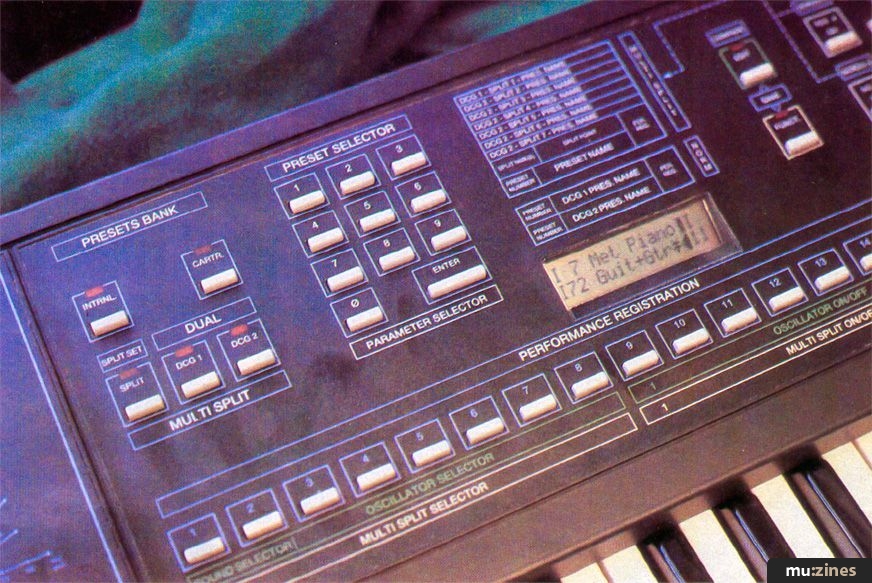
More to the point is, have they managed to improve on their example? The major advance is the increase in the polyphony. Doubled sounds are really strong since you've still got nine notes to play with instead of the 21's four. For extra on-stage speed the front panel carries 16 Performance Registration buttons calling up pairings of voices, and individual spec for the mod wheel, vibrato etc.
This niftiness is advisable as dialling up the individual voices can be slow — two numbers on the numeric pad, then enter, compared with the single key stroke of the DXs. The EK44 boasts excellent split keyboard facilities with up to eight different splits across the keys, each with its own sound, and each sound with its own MIDI channel — a trick similar to the FB01's, and very handy for multi-instrument sequencing.
Edit the EK44's sounds, and the similarity with the DX21 develops — frequency ratio, pitch envelope, etc. Happily I found the Elka easier to understand than some DXs, mainly because of the LCD. When each parameter is called up, a small display fills the bottom of the screen providing a visual clue to what's going on — bar graphs indicate the levels of the oscillators, plus and minus signs show the direction of the envelopes, spikes demonstrate balance, and so on.
Calling up the individual oscillators was speedier as well. Instead of having to step through the operators, as on the DX system, you can go straight to the oscillator desired by pressing the proper Performance Registration button (that old dual-mode operating thang.) A button marked 'Help' feeds you a line of instructions in case you get stuck but isn't as much assistance as you might hope. It just kept telling me where I was, and what I could copy.
DECISION
Sturdy, workmanlike and targeted on the professional. The multisplit in particular makes the EK44 immensely powerful, and the velocity sensitivity and second touch aid expression. The principle question is where the synth falls in the market. Nine layered notes are certainly the riches you'd expect from a pricey machine, but the basic sound generation is, after all, modelled on the DX21 which is almost half the price. One thing is for sure: don't be put off by the slightly unruly appearance of the front panel. It's a lot more sophisticated than it looks.
SPEC — ELKA ORLA EK44
| PRICE | £1299 |
| SOUND SOURCE | digital oscillators plus chorus unit |
| POLYPHONY | 18 note (9 when layered) |
| MEMORY | 64 presets plus 32 programmable. RAM or ROM cartridges |
| KEYBOARD | 5 octave C-C, velocity and second touch |
| SPLITS | up to eight split points |
| DISPLAY | 32 character LCD |
Also featuring gear in this article

Elka EK22/EK44 Synthesizers
(SOS Nov 86)

Elka EK44 & EK22 Synths
(EMM Oct 86)

Browse category: Synthesizer > Elka
Publisher: Making Music - Track Record Publishing Ltd, Nexus Media Ltd.
The current copyright owner/s of this content may differ from the originally published copyright notice.
More details on copyright ownership...
Making Music - Jan 1987
Review by Paul Colbert
Ads for Gear in this article:

Help Support The Things You Love
mu:zines is the result of thousands of hours of effort, and will require many thousands more going forward to reach our goals of getting all this content online.
If you value this resource, you can support this project - it really helps!
Donations for May 2026
Issues donated this month: 0
New issues that have been donated or scanned for us this month.
Funds donated this month: £0.00
All donations and support are gratefully appreciated - thank you.
Magazines Needed - Can You Help?
Do you have any of these magazine issues?
If so, and you can donate, lend or scan them to help complete our archive, please get in touch via the Contribute page - thanks!
If you're enjoying the site, please consider supporting me to help build this archive...
...with a one time Donation, or a recurring Donation of just £2 a month. It really helps - thank you!

 @mu_zines
 RSS Feed
 Blog
Blog