Behind the Scenes
Maintenance / Repair / Modification, Recording Studios
(HSR May 87)



Magazine Archive
Home -> Magazines -> Issues -> Articles in this issue -> View
DJM Develops | |
DJM StudiosArticle from International Musician & Recording World, July 1975 | |
The story of a studio's struggle from being "in-house" to fully independent

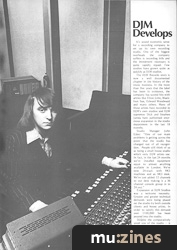
It's sound economic sense for a recording company to set up its own recording studio. One of the biggest overheads the company suffers is recording bills and the investment necessary is quite rapidly repaid. Few studios have grown quite as quickly as DJM studios.
The DJM Records story is now a well documented chapter in the history of the music business. In the more than five years that the label has been in existence, the company has scored hits with artists like Elton John, Blackfoot Sue, Edward Woodward and many others. Many of those artists have recorded in DJM's own studios' and DJM supremos Dick and Stephen James have authorised enormous expansion in the studio department in the last 18 months.
Studio Manager John Eden: "One of our main problems is getting across the point that the studio has changed out of all recognition. People still think of us as being a small house studio which only DJM artists use. In fact, in the last 24 months we've installed equipment equal to almost anything available in London. We're now 24-track with MCI machines and an MCI desk. We've just added 12 channels to our desk making it a 36 channel console group in to 24 out."
Expansion at DJM Studios was a welcome necessity. Greater and greater technical demands were being placed on the studio by both outside clients and house artists. In order to satisfy this demand over £100,000 has been poured into the studio.
Despite the comparatively small size of the studio — it was designed especially for group use, not for orchestras — the studio has been undertaking all types of music recording work, slipping brass section and small string sections in with surprising ease.
One of the most enviable conditions within the studio administration is that any spare time not sold to outside clients is taken up by house artists. Thus John and his staff are kept busy 100 per cent of the time.
"At the moment our time is split 50/50 between outside clients and house bookings with the emphasis slightly on the outside work. That is about comfortable for us. At the moment if anyone calls to book a session I'm looking six weeks or two months ahead and that's the way it should be, I suppose."

The recent expansion in the control room has added considerably to the consoles flexibility. "We're using the extra 12 channels for bringing up effects and things like that," explained John. "We've also added the usual extra compressor and limiters and outboard controllers so that we can use the channels for any re-insert we choose."
"MCI market an extension package for their 24 channel desk which tacks on so it looks just like a 36 channel desk. We've made room by removing the producers' table and just leaving them space for a coffee cup."
Recent months have seen a wide variety of artists tripping through the DJM soundproofed doors. The list includes Geno Washington, Moon Williams, John Richardson and Alan Williams of the Rubettes, Blodwyn Pig, Tremeloes, and Blackfoot Sue.
Like most good engineers and studio managers, John Eden's personality is responsible for the success of the studio. Recording is an intensely personal thing and the relationship between engineer and client is an important aspect of a successful bookings sheet.

Before joining DJM two years ago, John was an engineer with Marquee Studios in Wardour Street and it was there he gained his early experience in advanced multi-track recording. Before he came to London he was at West of England Studios and thus he has brought with him considerable recording experience.
"One of our main features here is mixing. For some reason it seems that the control room lends itself very well to mixing and we spend a lot of time doing reductions here."
Even greater things are ahead for DJM Studios though.
"At the moment we're looking for new premises in the W1 area. We've decided that the time has come for a move to a bigger building and I understand that we're now negotiating for a building right in the centre of London. It will be quite some time before any move takes place though."
Part of the present DJM complex that plays a major role in the studio's fortunes is the copying suite. Here a large number of house and outside client copies are made, both reel to reel, cassette, 8-track cartridge and disc to tape and all the equipment in the copying machines can be linked to the control room equipment.
The full DJM Studio control room specification is as follows: Control Room. MCI 36 in 24 out console, MCI 24-track machine with auto locate control, Studer A80 8-track, Dolbys throughout, Universal/Audio Design Limiters, Astronic/Parametric equalisers, automatic phasing unit, 8 Kepex units, two stereo EMT echo plates, JBL/Amcron monitoring.
More with this topic
 |
 Studio Diary |
 In The Lede - The Tape Gallery: putting itself in the picture |
 Auntie's Playroom - BBC Radiophonic Workshop |
 Town House Studio |
 Studio Of The Month - Studio 99 |
 The Hitch-Hiker's Guide To The Workshop |
 Making Studios Pay |
 Studio Of The Month - Flexible Response |
 The Vinyl Solution |
 EMI Studios - Abbey Road |
 Inside Abbey Road - Careers In The Music Industry (Part 1) |
Browse by Topic:
Recording Studios
Publisher: International Musician & Recording World - Cover Publications Ltd, Northern & Shell Ltd.
The current copyright owner/s of this content may differ from the originally published copyright notice.
More details on copyright ownership...

International Musician - Jul 1975
Donated & scanned by: Mike Gorman
Feature
Help Support The Things You Love
mu:zines is the result of thousands of hours of effort, and will require many thousands more going forward to reach our goals of getting all this content online.
If you value this resource, you can support this project - it really helps!
Donations for September 2026
Issues donated this month: 0
New issues that have been donated or scanned for us this month.
Funds donated this month: £0.00
All donations and support are gratefully appreciated - thank you.
Magazines Needed - Can You Help?
Do you have any of these magazine issues?
If so, and you can donate, lend or scan them to help complete our archive, please get in touch via the Contribute page - thanks!
If you're enjoying the site, please consider supporting me to help build this archive...
...with a one time Donation, or a recurring Donation of just £2 a month. It really helps - thank you!

 @mu_zines
 RSS Feed
 Blog
Blog